
Islamic Finance as a Catalyst for Global Sustainability at DIFC Summit

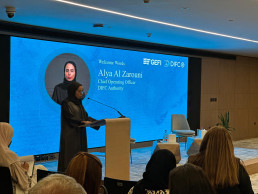
Alia Al Zarouni, Chief Operating Officer of the Dubai International Financial Centre (DIFC), addressed the Unlocking Islamic Sustainable Finance Summit, emphasizing the pivotal role of Islamic finance in sustainable development. She highlighted that Islamic finance inherently aligns with the United Nations Sustainable Development Goals (SDGs) due to its ethical and holistic framework.
Alia noted the significant growth of the Islamic finance market, currently valued at $4 trillion and expected to reach $6.7 trillion by 2027. She pointed out that the UAE accounts for over 40% of global sustainable issuances, many hosted within the DIFC, positioning the nation as a leader in sustainable finance.
To bridge the annual $6 trillion investment gap required by 2030 to meet climate targets, Alia outlined the DIFC’s key initiatives:
- Co-founding the Dubai Sustainable Finance Working Group to embed ESG principles and support Islamic finance potential.
- Launching the ‘Path to COP28’ program with the Global Ethical Finance Initiative (GEFI) to raise awareness and support financial sector transition.
- Announcing the region’s largest sustainable finance capital hub with ambitions to:
- Increase sustainability cash inflows to Dubai by $100 billion by 2030.
- Grow the sustainability-linked finance sector by 20%.
- Create an AI-enabled sustainability knowledge hub.
- Train 1 million sustainability leaders by 2030.
She concluded by calling for collaborative efforts to scale Islamic finance, not only to meet climate goals but to catalyse global decarbonization and resilience. “By harnessing the principles of Islamic finance and aligning them with the sustainable development agenda, we can foster a more equitable, sustainable, and prosperous future for all,” Alia affirmed.
Key Takeaways:
- Islamic Finance Alignment with SDGs: Islamic finance principles naturally support global sustainability goals.
- UAE’s Leadership Role: The UAE and DIFC are at the forefront of sustainable finance initiatives.
- DIFC’s Ambitious Goals: Significant initiatives are underway to bridge financing gaps and promote sustainable development.
- Call to Action: Collective efforts are essential to scale Islamic finance’s impact on global sustainability.

UN CBD COP16 Takeaways
This paper provides an overview for financial institutions of the most pertinent issues identified by Planet Tracker from the UN Biodiversity Conference (COP16) in Cali, Colombia. Topics range from the availability of nature transition plans, to who has responsibility for nature in government structures – it’s looking complicated, to the availability of nature data – or rather its processing and analysing. The struggle to finance countries’ nature and ecosystem services remained unresolved.
Financing nature: a mixed bag
It is widely recognised that there is a significant shortfall in financial flows into nature positive investments. In 2002, nature-based solutions (NbS) flows were USD200 billion. But these investments were overwhelmed by nature negative payments of USD6.7 trillion.i COP16 witnessed several discussions about environmentally harmful subsidies (EHS), as a potential solution to meet the funding shortfall through reallocation rather than relying on new sources. See ”Nature finance: is relying on subsidy reallocation realistic?”. The International Institute for Sustainable Development (IISD) intends to release a more detailed analysis of EHS later this year.ii
When nature flows are examined, so is the term “nature positive”. Aware of the manipulation of terms such “carbon positive” and “net zero”, and keen to avoid greenwashing claims, the Nature Positive Initiative (NPI) was very active in convening meetings to build a consensus on ‘The State of Nature’ Metrics.iii The NPI commented that it will carry on our work beyond the conference, providing a measurement framework to credibly report on progress towards nature-positive outcomes”.iv
Finance Ministers in the room
Many at COP16 were encouraged by the attendance of several Finance Ministers, implying that nature considerations are moving beyond the Environment and Agriculture Ministries.v The overarching challenge is whether the bioeconomy can be linked to the existing economic system. In our pre-COP16 blog – “What financial institutions need to know before the UN Biodiversity (COP16)” – we listed a range of financial instruments being used to finance nature. Planet Tracker sensed a growing unease over debt-for-nature swaps, largely because of their costs to sovereign states. Biodiversity credits continue to attract a lot of discussion assisted by the launch of the Framework for high integrity biodiversity creditvi markets by the International Advisory Panel on Biodiversity Credits, but with little to show in terms investment. Some question whether so much effort is worthwhile. To help scale these credits, the Biodiversity Credit Alliance has proposed digitally native frameworks.vii BloombergNEF (BNEF) estimated that less than USD 1 million of credits have been purchased to date.viii In comparison, it estimated existing biodiversity inflows are USD 208 billion annually.
The nature-linked instruments list is expanding
As expected, some issuers took the opportunity to publicise new nature-linked instruments. For example, the Inter-American Development Bank (IDB) and BBVA Colombia, announced the placement of the first thematic bond with an exclusive focus on biodiversity projects in Latin America and the Caribbean.ix Meanwhile, the International Finance Corporation (IFC) announced an investment of up to US$50 million in a biodiversity green bond issuance by Banco Davivienda, to finance Colombian projects aimed at conserving, protecting, and restoring biodiversity and nature.x An USD 60 million ‘Country Package’ for Forests, Nature, and Climate collaboration was announced by France, the Fonds d’amorçage des Partenariats Pays, The Nature Conservancy (TNC), the Global Environment Facility (GEF), and the United Nations Development Programme (UNDP), which will work together to support Gabon’s commitments to forests, nature, and climate via the Global Biodiversity Finance Initiative (BIOFIN).xi
Also worthy of mention is the partnership between WWF and European Investment Bank (EIB). The former will establish an ‘incubation facility’ to develop a pipeline of Nature-based Solutions from origination until they are investment-ready, while the latter will provide guidance on mobilising public and private funding for them.
From the negotiations room
Progress was made in negotiations regarding sharing benefits from use of digital sequence information on genetic resources (DSI), despite opposition from the International Federation of Pharmaceutical Manufacturers and Associations (IFPMA). It stated, “The ability to rapidly use scientific data known as “digital sequence information” (DSI) is essential for developing new medicines and vaccines. Any new system should not introduce further conditions on how scientists access such data and add to a complex web of regulation, taxation and other obligations for the whole R&D ecosystem – including on academia and biotech companies.”xii (Note that academia is exempt under the guidelines.) In contrast, the Convention for Biological Diversity (CBD) heralded this agreement as “a historic decision of global importance”.xiii This mechanism is likely to affect pharmaceutical, nutraceuticals, cosmetics, biotechnology, animal and plant breeding and other related industries which benefit from DSI.
Under the agreed guidelines, entities benefiting commercially from DSI uses should contribute to “the Cali Fund,” The draft decision defines entities as which on their balance sheet dates exceed at least two out of three of these thresholds (total assets: USD 20 million sales; USD 50 million; profit: USD 5 million) averaged over the preceding three years, should contribute to the global fund one percent of their profits or 0.1 percent of their revenue, as an indicative rate. (Note the use of the word ‘should’ implies this is a voluntary scheme.) At least half of the funding is expected to support the self-identified needs of indigenous peoples and local communities (IPLC) through government or by direct payments through institutions identified by indigenous peoples and local communities. Exempt from such payments are academic, public research institutions and other entities using DSI but not directly benefiting. On a related subject, but likely to receive limited headlines was new, voluntary guidance on assessing the risks posed by living modified organisms (LMOs) containing engineered gene drives. This guidance aims to improve international biosafety management and increase scientific rigo”.r and transparency of risk assessment procedures. There was also an agreement for an expert group to guide identification of synthetic biology’s potential benefits and review the potential impacts of recent technological developments. See Planet Tracker’s “Long AI, Short Nature: Close the Short”.
There was no agreement reached on how to fund the deficit for global biodiversity initiatives by 2030. As negotiations overran the allotted time, the COP became inquorate. The CBD stated that Parties at COP 16 “will resume at a later date and venue to complete the agenda”.xiv Nor was there a decision on a new dedicated global financing instrument for biodiversity to receive, disburse, mobilize and articulate funding needs.
Planet Tracker believes that the importance of the insurance industry warranted even more attention. Insurance companies are vital to the financial system because they are large investors in financial markets, because they provide important links with banks, and because insurers safeguard financial stability by insuring risks. Changes in climate and nature are highly relevant to risk controls, and therefore the global capital markets.
Nature transition plans
The nature community has never been too proud to learn from its climate change predecessors. And so it is with nature transition plans, especially because of the climate/nature overlap. With agriculture, forestry, and land-use change accounting for nearly one-quarter of global greenhouse gas emissions, and it also being the largest driver of nature loss – which has seen a 73% average fall in species population numbers between 1970-2020xv – releasing a strategy with actionable steps to achieve science-based nature targets, as with climate, appears a required ask from financial institutions.
And there are transition plan outlines readily available or in the consultation process. In November 2023, Business for Nature published ‘Now for Nature’ which outlined high-level business actions on nature.xvi At the beginning of 2024, WWF recommended integrating nature into climate plans as well as integrating nature positive objectives in supports of transition planning.xvii At COP16, the Taskforce on Nature Related Financial Disclosures (TNFD)xviii released its discussion paper on nature transition plans and so did the Glasgow Financial Alliance for Net Zero (GFANZ).xix CDP published a useful paper at COP16, which summarises nature strategies and transition plans, providing a brief overview of each one.xx Further assistance is available from the Science Based Targets Network (SBTN) which set the first corporate science-based targets for nature. At COP16, the first three firms announced validated science-based targets for nature – GSK [GSK], Kering [KER] and Holcim [HOLN].xxi WBCSD is helping companies on nature positive journeys by providing guidance for credible business actions for specific value chains.xxii And if that is not enough, expect more nature transition plan assistance from both WWF and World Economic Forum before the year-end.
Oceans in the mix
Planet Tracker was pleased to see an increased focus on oceans. Work on protecting ecologically or biologically significant marine areas (EBSAs) began in 2010 but was stopped for more than 8 years due to legal and political concerns. At COP16, new mechanisms to identify new EBSAs and update existing ones, was agreed. This will ensure that the cataloguing of information of these areas can support planning and management with the most advanced science available.xxiii This is an important part of the implementation of the 30×30 protected areas targetxxiv and to prepare for the future implementation of the new agreement for marine biodiversity beyond national jurisdiction.
Government policy – where does nature fit in?
While corporates and financial institutions discuss who should oversee nature responsibilities, it is the same for governments. (Note that some corporates have appointed Nature Officers – see the Nature Scorecard). Should nature issues be overseen by environmental departments, or perhaps climate or land-use ones? What was often repeated in discussions was that finance ministries need to be convinced as do those officials responsible for agriculture, fisheries & farming. Unsurprisingly, many argued for a holistic approach, mainstreamed in all government departments and central banks; certainly, this would be ideal, but the hardest to achieve.
Governments are struggling to sort out this issue as they compile national biodiversity strategy and action plans (NBSAPs). Is this one possible reason for the disappointing number of NBSAPs submitted before COP16. To date 44 Countries (out of 196) have submitted their NBSAP. In line with the Global Biodiversity Framework (GBF), countries that were “not in a position” to meet the deadline to submit NBSAPs ahead of COP16 were requested to instead submit national targets. These submissions simply set down biodiversity targets that countries will aim for without an accompanying plan for how they will be achieved. By the end of COP16, some 119 parties had published some national targets. xxv
Nature data – overwhelming?
The refrain that there is not enough data on nature and biodiversity was debunked many times at COP16. There are various methods for collecting this data, including remote sensing & camera trapping, environmental DNA (eDNA), bioacoustics, and satellite imagery. And technology is helping to make these collection methods more precise. For example, satellite imagery is able to analyse data in 10cm squares. The European Space Agency is making biodiversity data a priority for 2025.xxvi As more data collection methods are invented, they become cheaper. For example, insects and pollinators can be monitored by using a device which uses low cost 2G, powered by solar, costing around USD 250 device.xxvii eDNA is also proving particularly versatile in both aquatic and terrestrial environments, and to a lesser extent in air.xxviii However, it is becoming increasingly clear that despite improved collection methods, no single process is completely reliable. The combination of satellite data with ground-based analysis, on the other hand, looks very promising.
There appear to be two main problems with biodiversity data. Firstly, there is an apparent backlog in the processing and analysing of these vast data sets. Are we being overwhelmed with biodiversity data maybe a more relevant question; will AI provide quicker insights? Secondly, the standardisation of nature data is a challenge. The frequent comparison with climate metrics has built up an expectation of a single measure – i.e. equivalent to 1.5°C of warming – using a single unit of measurement – i.e. CO2e – across the globe. Nature and biodiversity are unlikely to be condensed into one unit of measure – e.g. species or ecosystem health or habitat quality – across all the world’s biomes. But that does not mean that an improvement of nature in a variety of ecosystems cannot be measured and achieved.
The rise and rise of social considerations
Receiving considerable airtime at COP16 were the rights of indigenous peoples and local communities (IPLC). According to the 2018 Colombian census, there are 1.9 million individuals belonging to 115 different indigenous groups in the country. Expect more focus on these rights when the 2025 climate COP (COP30) takes place in Belém, Brazil. Brazil is home to 266 indigenous peoples with a population of 1,693,535 people, or approximately 0.83% of the total Brazilian population.xxix
At COP16, a new programme (Article 8[j]) was agreed that sets out specific tasks to ensure the meaningful contribution of IPLC towards the three objectives of the Convention – conservation of biodiversity, sustainable use of biodiversity, and fair and equitable sharing of benefits. In this programme, rights, contributions and traditional knowledge of indigenous peoples and local communities are further embedded in the global agenda. A new Subsidiary Body is expected to elevate issues related to the implementation of Article 8j and enhance the engagement and participation of indigenous peoples and local communities in all convention processes.xxx
Until next time
The COP16 convention was not officially closed, so further progress is possible to try and resolve the outstanding funding issues prior to the next CBD COP. Astrid Schomaker, Executive Secretary, Convention on Biological Diversity stated, “It will resume at a later date and venue to complete the agenda”.xxxi Armenia was elected as the host of COP 17, to be held in 2026.
Memorable quotes from sessions attended
“The present economy is a bioeconomy as it is reliant on nature. But today’s bioeconomy is nature negative which means it is not sustainable. We need a new bioeconomy.” (Marco Lambertini, Convener, Nature Positive Initiative)
“We are eating the planet that feeds us. What kind of fertiliser do you wish to be for the planet?” (Indigenous leader at TNFD Adopter event)
“The present economic system incentivises nature negative policies by encouraging the likes of deforestation and overfishing, promoted by subsidies.” (Tony Goldner, Executive Director, TNFD)
“It is not a coincidence that the slowest rates of deforestation in Brazil are those inhabited by indigenous communities.” (Ceiça Pitaguary, National Secretary for Environmental and Indigenous Territorial Management, Ministry of Indigenous Peoples, Brazil)
“Presently nature data is roughly five years behind climate data.” (Christian O’Dwyer, Sustainable Finance Solutions Product Manager [Nature & Biodiversity])
“The Amazon is not just the lungs of the planet, but also its heart as it is the centre of the hydrological climate system.” (Atossa Soltani, Amazon Sacred Headwaters Alliance)
“When developing land restoration projects, the problem is not the solutions but the scaling.” (Daan Groot, Managing Director, Nature^Squared)
“The OECD has seen a doubling of biodiversity–related financing between 2017-2022, mainly from multi-lateral banks.” (Kumi Kitamori, Deputy Director, Environmental Directorate, OECD)
“Between 1992 and 2014, while produced capital per person doubled and human capital per person increased by about 13%, the stock of natural capital per person declined by nearly 40%” – The Interim Report of the Expert Review on Debt, Nature & Climate: Tackling the Vicious Circle
“We know what the problem is.” Susana Muhamad, Colombian Environment Minister and COP16 President
“Nature does not stand alone.” Executive Director of the United Nations Environment Programme
References
ii The International Institute for Sustainable Development (IISD) – Global Subsidies Initiative
iii Nature Positive Initiative – Have your say in how nature can be measured
ivNature Positive Initiative – Closing Statement at COP16 (November 2024)
v The Coalition of Finance Ministers for Climate Action – Role of Ministries of Finance in achieving commitments set out in the Global Biodiversity Framework (October 2024)
vi International Advisory Panel on Biodiversity Credits – Framework for high integrity biodiversity markets (October 2024)
vii Biodiversity Credit Alliance – Strategic Plan for the Biodiversity Credit Alliance (August 2024)
viii BloombergNEF – Biodiversity Factbook: COP16 Edition
ix IDB Invest – IDB Invest and BBVA Colombia Announce Successful Placement of First Biodiversity Bond by a Financial Institution in LAC (October 2024)
x IFC – IFC Invests in Biodiversity Bond Issued by Davivienda to Support Sustainable Finance and Biodiversity Protection in Colombia (October 2024)
xi The Nature Conservancy (TNC) – US $60 Million Collaboration to Protect Gabon’s Forests and Combat Climate Change (October 2024)
xii The International Federation of Pharmaceutical Manufacturers and Associations (IFPMA) – Statement from Director General on Conclusion of COP16 Negotiations on Multilateral Mechanism for Benefit-Sharing of DSI (November 2024)
xiii CBD – Biodiversity COP 16: Important Agreement Reached Towards Goal of “Making Peace with Nature” (November 2024)
xiv Convention on Biological Diversity (CBD) – Biodiversity COP 16: Important Agreement Reached Towards Goal of “Making Peace with Nature” (November 2024)
xv WWF &ZSL – Living Planet Index
xvi Business for Nature – It’s Now for Nature
xviii TNFD – Discussion paper on nature transition plans (October 2024)
xix GFANZ – Nature in Net-zero Transition Plans (October 2024)
xxi Science Based Targets Network (SBTN) – SBTN announces first companies publicly adopting science-based targets for nature (October 2024)
xxii WBCSD – Roadmaps to Nature Positive
xxiii CBD/COP/16/L.8 – Further work on ecologically or biologically significant marine areas (October 2024)
xxiv Convention of Biological Diversity (CBD) – Target 3 of the Kunming-Montreal Global Biodiversity Framework.
xxv CBD – Revised and updated NBSAPs (accessed 30 October 2024)
xxvi European space Agency – Observing the Earth
xxviii NatureMetricsTM – eDNA and Biodiversity Monitoring Solutions
xxix IWGIA – The Indigenous World 2024
xxx CBD – Biodiversity COP 16: Important Agreement Reached Towards Goal of “Making Peace with Nature” (November 2024)
xxxi Convention on Biological Diversity (CBD) – Biodiversity COP 16: Important Agreement Reached Towards Goal of “Making Peace with Nature” (November 2024)
Supporting a Just Transition: the Human Impact of the Journey to Net Zero
One of the greatest challenges we currently face is how to support the transition towards a more climate aware society without leaving people behind economically. COP28 last year in Dubai called for the transition from fossil fuels in a just, orderly, and equitable manner, but what could be the social impact from this? Lauran Halpin, Head of Impact Equities has participated in a number of recent forums and discussions in partnership with the Global Ethical Finance Initiative (GEFI) to discuss just that.
Martin Currie and GEFI have partnered because of a shared belief that private finance, especially in equity markets can have a pivotal role in helping solve social challenges. The ‘S’ in Environmental, Social and Governance is often overlooked, but even with the focus on climate related issues, there is a very human dimension within this that needs to be considered – a ‘just transition’.
What is a just transition?
The concept of a ‘just transition’ is a framework aimed at ensuring that the shift towards a low-carbon, sustainable economy is fair and inclusive. Its origins are from North American labour unions in the 1970s and 1980s seeking to protect workers impacted by (then) new water and air pollution regulations. The unions sought to align efforts to protect the environment while providing workers with decent jobs.
Today, this concept has found traction in a climate change context. It seeks to support those most affected by the low-carbon transition, and includes workers, vulnerable communities, the suppliers of goods and services, notably small and medium enterprises (SMEs) and finally, consumers. Action is needed because the impacts of climate change on people are uneven, and so too are the impacts of the mitigating actions. These can range from closing fossil fuel plants to the environmental impacts of climate change itself.
What are the key issues?
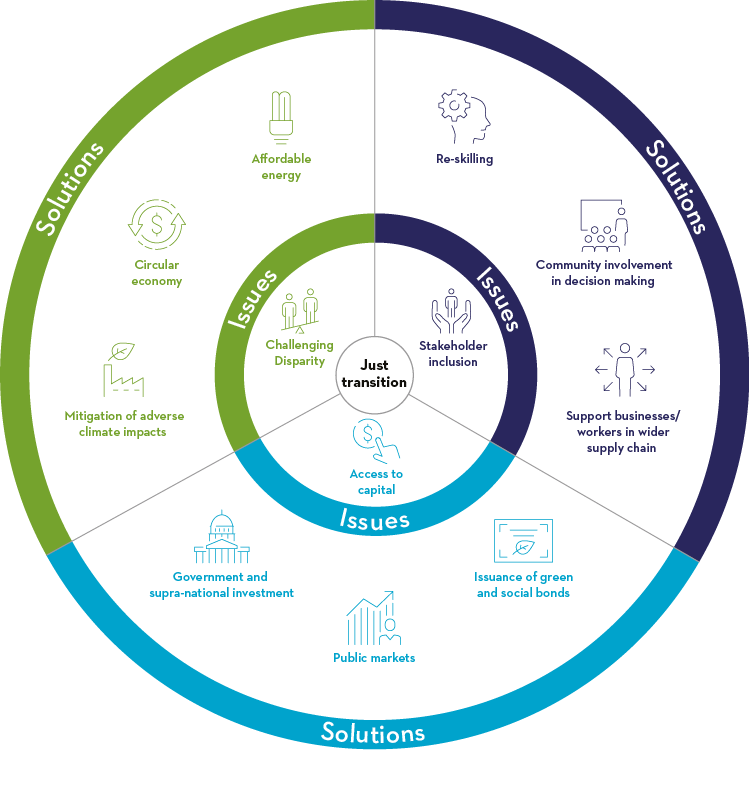
It is important for us not to leave anyone behind and to harness the opportunities for people, communities and enterprises that transition presents. We believe three of the biggest challenges facing a just transition are:
- Challenging disparity. Ensuring that the benefits and burdens of the transition are distributed fairly across different regions and communities is complex. We need to consider the impact on regions and communities that are more dependent on employment from fossil fuels. Substantial investment is needed to fund re-training and education for workers changing to new industries. Affordable energy needs to be available to all, ending- not worsening- fuel poverty. The Global South (that broadly comprises Africa, Latin America and the Caribbean, Asia, and Oceania) needs a stronger focus, as countries with fewer economic resources and limited social safety nets may struggle to meet the pressures on livelihoods. The circular economy has a role to play here in making better use of existing resources and products while reducing waste and pollution. This can also aid the mitigation of climate related socio-economic impacts through food/resource scarcity and adverse weather.
- Stakeholder inclusion. It should almost go without saying that to make the transition ‘just’, engaging with workers, communities and businesses is crucial. Otherwise, the needs of those most affected may not be addressed. This includes how companies adopt fair labour practices and involve local communities in decision-making processes. Re-skilling is key to this, but it must provide workers with the education relevant to changing workplaces, for example digital skills. There is also the ‘informal sector’ to consider, how are businesses and the workers in the wider supply chain impacted? What impact does this have on the safety and resilience of a community?
- Access to capital. New financing instruments are needed to help achieve the transition. The European Commission has launched the Just Transition Mechanism, based on three pillars: a Just Transition Fund, a just transition scheme under InvestEU, and a public sector loan facility. This initiative has not been without contention regarding distribution of funds between different countries. Issuance of green, social and sustainability (GSS) bonds have grown in the last 10 years, after a peak of almost a USD 1 trillion in 2021, c.USD 850 billion were issued in 2023. The vast majority are however green bonds, with social bonds accounting for just over US$150 billion of the 2023 issuance2. Further issuance of social or wider sustainability bonds could appeal to many socially responsible investors to raise capital for transition projects. But in providing funding, we strongly believe in the role of public markets to accelerate investment and aid scalable solutions. We discuss this further below.
What role can asset managers play?
The private sector can support the process through company-level practices and by facilitating corporate investments in a just transition.
A holistic approach needs to be considered. Through public markets we can invest in companies that help society adapt and become more resilient – physically and economically speaking – to the uncertainty that lies ahead. They do this by re-skilling workers, increasing their efficiency or resource usage, and improving the safety and resiliency of communities. The provision of financial services to underserved communities through microloans and savings accounts can improve financial inclusion and increase financial resilience.
How can we help stakeholders and provide communities with voices? Asset managers, through proper due diligence, can seek to identify those companies who are materially helping the transition and supporting stakeholders. This can be through innovative products and services from well governed companies, they have economic incentive to aid the transition as it helps the firm’s bottom line.
As asset managers we can also consider what the material impacts are both up and downstream on suppliers and consumers. A firm might consider its environmental offsets, but what is its impact on actual people, especially in more disadvantaged regions?
Targeted engagement by asset managers focusing on these material issues can improve corporate behaviour, and accelerate the positive change created by the firm’s products and services.
The financial sector can also advocate at an industry and government level for policies that support a just transition, such as subsidies for green technologies, social safety nets for displaced workers, and regulations that promote fair labour practices. Collaboration with other investment firms and investor-led initiatives can amplify these efforts.
Reasons to be optimistic
There is real momentum behind a just transition; we are seeing more carbon reduction and low emission policies now including explicit references to economic diversification, job creation, skills training, and social protection. The International Energy Agency has established a Global Commission on People-Centred Clean Energy Transitions, with its principles based on energy affordability and socio-economic developments. Several countries have implemented coal transition plans including Canada, Germany, Czechia, Spain and South Africa. They have varying approaches, and are at different stages of implementation, but all acknowledge the need for reskilling and community impact.
We are seeing innovation at companies offering technological solutions to mitigate the impact of climate change for communities. In the just transition space this includes companies that are focused on reskilling people from overlooked cohorts for high demand areas. Supporting the circular economy are companies helping improve the efficiency and resiliency of industrial processes, especially in the food and health sectors, or recycling wastewater. Others are providing solutions to support communities through resilience to natural disasters or improving the safety of more sustainable forms of transport.
As asset managers we are optimistic. We see improvements in disclosure around sustainability topics by companies, but we note that this is still developing. At Martin Currie, our own impact strategy’s company engagement has primarily been around this issue. Specific engagement with companies can also help accessibility of impact, for example encouraging expansion of products or revenue generation in regions such as emerging markets. By setting clear metrics and targets for products and services that deliver positive social outcomes, asset managers can track progress and ensure accountability to underlying investors. That way we can use public market investment to help accelerate a just transition.
This guest article was written by Lauran Halpin, Head of Impact Equities, and was published in Martin Currie’s 13th edition of Stewardship Matters that focusses on social impact and the potential of public markets to address societal challenges while assessing the risks these issues present to achieving financial returns for investors.
Accuracy Welcome

Sophie Chassat, Accuracy opened the Sustainable Finance Summit with a warm welcome to attendees and key figures whose efforts brought the day to life.
The summit tackled a pressing question: “Is it the end of sustainable finance?” Sophie addressed the current challenges in the sector—rising resistance to ESG principles, limited capital for sustainable investments, and geopolitical issues that often push sustainability to the side lines. These pressures, she noted, might make sustainable finance seem at a crisis point.
Yet Sophie emphasised that there were compelling reasons for optimism. Green investing, she highlighted, is far from over. As Paul Polman, former CEO of Unilever, recently noted, ESG investment continues to thrive. Investment in green assets grew by $3.4 billion in 2023, a 15% increase from the previous year. Moreover, over half of investors plan to increase sustainable investments in 2024, with 77% showing interest in such strategies. Far from faltering, sustainable finance is expanding, supported by tangible demand.
Sophie concluded by suggesting that the future of finance lies in embedding sustainability at its core, moving beyond separate green categories to make it foundational to all financial activities. The day’s panelists would explore this transformative vision, examining how sustainable finance could define a new era in the financial landscape.
GEFI Welcome

Omar Shaikh, Managing Director, GEFI, expressed his delight as he welcomed attendees to the GEFI and Accuracy co-hosted summit in Paris. Building on a fruitful partnership from last year’s Path to COP28 campaign—the largest finance-driven initiative for the UN Climate Summit—Omar highlighted the shared commitment to champion sustainable finance on a global scale. This collaboration, he noted, had proven the power of aligning ethical finance with strategic financial expertise to address the climate crisis, setting the stage for today’s discussions.
The strategic alliance between GEFI and Accuracy was formed with the goal of driving positive change in finance, addressing the demand for ESG, navigating regulatory landscapes, and devising practical approaches for financing a just transition. Omar warmly acknowledged Accuracy’s support and the hospitality of Paris, which he humorously compared to their warm reception in Scotland, the “natural home of green finance.”
The summit’s theme centred on an urgent question: “Is this the end of sustainable finance as we know it?” Omar pointed out that a quick glance at today’s challenges—anti-ESG sentiment, capital outflows from ESG funds, and geopolitical tensions—might suggest a moment of crisis. Yet, he argued, these issues did not tell the whole story. Sustainable finance is not waning; it’s evolving. European regulations such as SFDR and CSRD and rising asset owner demands are embedding sustainability within the fabric of finance.
The question, then, is whether we are on the cusp of a new era—one in which sustainability isn’t a separate agenda but is seamlessly woven into all financial activities. Omar invited attendees to engage deeply in the day’s sessions, pose questions, and help shape the future of sustainable finance.
In closing, he expressed excitement for the inspiring discussions ahead, underscoring the importance of this collaborative journey to make sustainable finance mainstream.
Closing Remarks
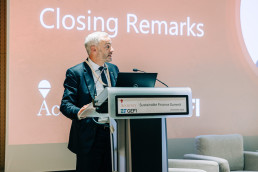
Reflecting on the numbers shared, the path forward seemed daunting. The financing needs for sustainable initiatives stretched to around $4.3 to $5 trillion per year, roughly 5% of the global GDP of $100 trillion. For many, this appeared insurmountable, yet it underscored the demand not only for funding but for innovation and transformation.
The End of ESG or Just the Beginning?
David Chollet, Accuracy observed that ESG had evolved beyond a strategic option to become a necessity. The pressing question was no longer whether a company had an ESG strategy but whether it had a strategy that would sustain it in an increasingly interdependent world. This marked a turning point where action took precedence over mere messaging.
Three Key Takeaways
- Scale of Investment Needs
The scale was unprecedented. For example, the energy sector alone demanded $1 trillion in new investments. However, this wasn’t just about pouring money into projects; it was about fundamentally transforming business models. Business-as-usual approaches were no longer viable. - A Financial Opportunity with Patience
This transformation presented financial opportunities but required a longer return on investment. Much like a “J-curve,” the rewards might not be visible for over a decade. This shift called for an adaptation in investor mindsets, with blended finance and innovative models gaining attention. The triad of corporations, public sectors, and financial markets had to collaborate to drive forward lasting solutions. - The Need for Urgency
Timing was critical—later was simply too late. David emphasised the need to think creatively, potentially introducing “green quantitative easing” or “green helicopter money.” Bold, accelerated action was essential to make a sustainable impact.
In closing, David reminded attendees: there was no sustainability without profitability, and no sustainable company could exist in an unsustainable world. As the French group Daft Punk famously put it, the need was to act better, faster, stronger.
ESG Integration: Enhancing Profitability and Managing Risks


In her keynote, Julie Malzac explored the complex relationship between ESG integration and its impact on profitability, risk management, and long-term value creation for businesses. With an evolving regulatory and market landscape prioritising sustainable practices, Julie’s insights clarified why ESG integration is becoming essential and provided a roadmap for overcoming the challenges of aligning it with traditional financial metrics.
Key Insights and Takeaways:
- Financial Impact of ESG Controversies:
Julie underscored the financial risks of failing to manage ESG issues, noting that companies involved in controversies often face substantial financial losses. This underscores ESG’s critical role in risk management, where proactive ESG integration can help prevent significant value destruction. - Disconnect Between ESG and Profitability Perceptions:
While many investors view ESG as an effective risk mitigation tool, the link between sustainability and profitability isn’t always clear. This perception gap leaves some companies hesitant to fully integrate ESG, as they weigh the immediate costs against perceived financial benefits. - Outperformance of Sustainable Funds:
Studies reveal that sustainable funds frequently outperform traditional ones, and companies with high ESG ratings typically enjoy lower costs of capital. This not only reduces financing costs but also enhances revenue growth and operational efficiency by bolstering stakeholder trust and brand reputation. - Low ESG Integration in Corporate Strategies:
Only around 50% of investors and companies report full ESG integration into their strategies. This low adoption rate can be partly attributed to measurement challenges and the struggle to balance short-term financial goals with the longer-term nature of sustainability initiatives. - Challenges in Measurement and Timing:
The short-term outlook of conventional investing often clashes with the long-term horizon required for sustainability objectives. Difficulties in measuring ESG’s immediate impact make it hard for companies to justify the costs of full integration, particularly given pressures for quarterly returns. - European Leadership in ESG:
Europe remains the global frontrunner in ESG adoption, leading regulatory and market standards that may eventually influence other regions to catch up. For companies outside Europe, however, the less defined regulatory framework complicates their path to sustainable transitions and makes ESG integration harder to justify against immediate financial pressures.
Conclusion
Julie’s keynote underscored that companies leading in ESG are often best positioned to not only manage risks but also gain a competitive edge. She advocated for companies to approach ESG as a strategic asset, rather than a compliance checkbox, as this can drive profitability, enhance brand loyalty, and strengthen relationships with stakeholders. With the right approach, the long-term alignment between sustainability and profitability could reshape corporate strategy, creating lasting value for businesses and society alike.
In a world that increasingly favours sustainable business practices, the integration of ESG is not merely an ethical choice; it is a sound financial strategy for future-proofing and resilience in an ever-evolving market landscape.

ESG Today: Analysing Market Dynamics


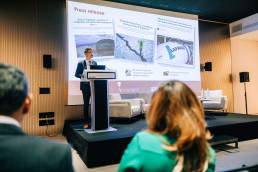
Julie Malzac’s presentation on ESG market trends provided valuable insights into how businesses and investors are navigating the shifting landscape of sustainable finance. She discussed the importance of integrating ESG principles into both business operations and investment strategies, and how recent regulatory developments, such as the EU Taxonomy and Sustainable Finance Disclosure Regulation (SFDR), are guiding these efforts. These regulatory frameworks aim to enhance transparency and accountability, setting clearer standards to ensure that investments truly contribute to environmental and social goals.
One of the key challenges Julie highlighted is the financing gap required to meet the United Nations Sustainable Development Goals (SDGs) and achieve net-zero carbon targets. This gap is estimated to be around $5 trillion annually—a daunting figure that underscores the need for robust solutions in sustainable finance. Current investments, though growing, fall short of the capital required to tackle climate change and meet global development objectives.
Closing this financing gap will require a coordinated effort across sectors. Julie called for innovative financial solutions, such as blended finance and green bonds, which can help attract more private sector investment into sustainable projects. These solutions, coupled with stronger regulatory frameworks, have the potential to mobilise significant capital flows towards initiatives that support climate action, environmental protection, and social development.
In her closing remarks, Julie emphasised that meeting sustainability goals is not solely the responsibility of policymakers or investors but a collective endeavour. Businesses, investors, and regulators alike must work together to bridge the financing gap and ensure a sustainable, resilient future.
Key Takeaways:
- Regulatory frameworks like the EU Taxonomy and SFDR are shaping ESG practices.
- A $5 trillion annual investment gap remains for achieving SDGs and net-zero goals.
- Increased private investment and innovative finance solutions are essential.
Conclusion
Julie’s session serves as a reminder of the importance of commitment and collaboration in sustainable finance. By aligning corporate, regulatory, and investor actions, the financial industry can make significant strides toward a more sustainable and equitable world.
Charting the Path Forward: Innovations and Trends in ESG and Sustainable Finance
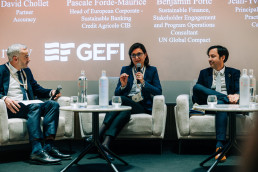



The final panel discussion at the summit was moderated by David Chollet, Accuracy and delved into the evolving landscape of sustainable finance, spotlighting recent advancements, challenges, and methodologies driving this critical sector forward. Panelists included Jean-Yves Wilmotte from Carbone 4, Pascal Forde Maurice from Credit Agricole CIB, Benjamin Porte from the UN Global Compact, each offering a unique perspective on the sustainable finance ecosystem.
Jean-Yves emphasised a notable shift in climate strategies, with companies moving beyond basic carbon footprint reductions to rethinking core business models. This transformation includes broader stakeholder engagement and a focus on sustainable value creation, reflecting an evolution in corporate responsibility.
Pascal highlighted the rapid expansion of sustainability-linked bonds and loans, which incentivise companies to meet specified environmental or social targets. These instruments have gained traction as effective tools for aligning financial success with sustainable outcomes, indicating a growing market demand for impact-focused investments.
Benjamin from the UN Global Compact discussed the CFO Coalition’s initiatives aimed at engaging corporations to help bridge the $4.3 trillion annual financing gap for the Sustainable Development Goals (SDGs). By involving CFOs in this effort, the coalition hopes to mobilise corporate finance toward impactful and measurable sustainability goals.
The panel explored the importance of standardised ESG reporting frameworks and innovative tools for accurate emissions tracking. Emphasis was placed on leveraging technology—including big data, AI, and blockchain—to improve ESG data consistency and comparability. Rather than waiting for perfect data, panelists stressed the need for companies to act based on available information.
Blended finance solutions and instruments like sovereign sustainability-linked bonds were discussed as means to make sustainable finance more attractive, especially in emerging markets where risks can be perceived as higher. The example of Uruguay’s sovereign sustainability-linked bond framework highlighted the potential of public-private partnerships to create attractive investment opportunities in these regions.
As sustainable finance grows, the panel addressed potential risks of over-investment in certain sectors, urging for a balanced approach to ensure broad-based impact across various sustainability areas. This requires carefully weighing investments in established sectors like renewables with emerging areas that may yield significant, though sometimes less immediately obvious, benefits.
An in-depth discussion on the future of carbon footprint calculation underscored the importance of advanced tools for precise emissions data. With new methodologies enabling more granular insights, businesses are better equipped to track their environmental impacts and meet ESG targets. Standardised frameworks and consistent ESG data are crucial for investors who need reliable benchmarks, and while big data, AI, and blockchain are being explored for data management, the panel emphasised that enough data exists to initiate action today.
The panel also focused on debunking misconceptions about the inherent risks associated with investing in emerging markets, highlighting the need for better partnerships between governments, investors, and standard setters to enhance the appeal of sustainable finance in these regions.