UNEP FI Guidance for Guidance on Effective Governance
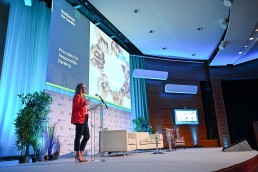
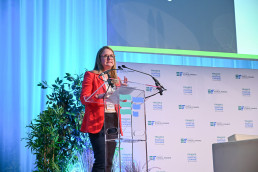
Laura Lightbody, Governance & Legal Counsel at UNEP FI, joined the Summit to present UNEP FI’s new Guidance on Effective Governance.
Against a rapidly evolving sustainability landscape, robust governance and internal culture are indispensable for organisations in navigating the technical, commercial and ethical complexities.
Sustainability governance, that is the organisational structures, systems and processes put in place to govern environmental and social strategies, plays a critical role in supporting sustainability progress and especially in overseeing delivery against sustainability commitments. Aligning internal operations and ways of governing with such commitments is an important step, promoting accountability and credibility.
Closely connected to Sustainable Development Goal (SDG) 16: Peace, Justice and Strong Institutions institutional strength and soundness are elements which act to bind businesses to the communities in which they operate and serve.
This guidance was specifically developed by banks for banks together with UNEP FI and importantly with valuable input and advice from civil society organisations. It is designed to support and enable implementation of the Principles for Responsible Banking (PRB or Principles, used interchangeably throughout), specifically focussed on Principle 5: Governance and Culture.
Banks are facing a multitude of new sustainability regulation, while also balancing legal challenge connected with this agenda and increasing societal expectations. Drawing on key regional and global regulation, relevant international standards and best practices from signatories of the PRB, the guidance aims to help by:
- Inspiring and informing banks on effective sustainability governance practices
- Helping banks to navigate the significant internal transformation required to translate their sustainability commitments into action
- Supporting banks in approaching compliance with relevant governance-related sustainability standards and guidelines.

Leadership and Purpose: In Conversation with Sandy Boss

This year we were pleased to have BlackRock, one of the world’s leading providers of investment, advisory and risk management solutions, participating in the Summit.
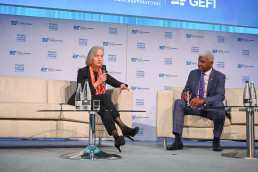
George King IV, Senior Wealth Manager at MASECO Private Wealth, was tasked with facilitating a discussion on leadership and purpose with Sany Boss, Senior Managing Director and Chair at BlackRock UK.
Sandy outlined BlackRock’s purpose of helping clients achieve long-term financial well-being, primarily focused on retirement savings. She stressed the importance of delivering strong financial performance while also supporting clients’ goals for decarbonisation and net zero emissions. Sandy noted BlackRock’s role in supporting clients through stewardship and engagement with companies, and how blended finance can be an effective route to mitigate risks associated with emerging markets and support sustainable projects.
The complexities of the current investment landscape, including the energy transition and geopolitical risks, were amongst the topics covered in the conversation.
“We’re in a multi-decade, complete rewiring of the energy system. Every company, every business, every country is being changed because of this rewiring. This transformation will involve an estimated $4 trillion annually over the next decade, up from $2 trillion in 2020,” Sandy stated.
On the leadership front, Sandy underscored the importance of company culture, client-centricity, and ownership in driving performance and innovation. She encouraged a proactive approach to investing in a rapidly changing world, highlighting the need for collaboration across industry stakeholders.
Ethics and AI
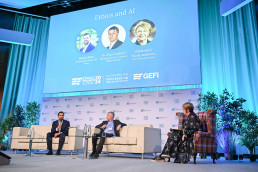

Nicola Anderson, CEO, FinTech Scotland, Giles Cuthbert Managing Director, Chartered Banker Institute and Sarwar Khan, Sustainability Director, BT Group joined this fireside chat that delved into the ethical dimensions of integrating AI into financial services and how we can harness technology to drive sustainable outcomes.
The discussion kicked off looking at the importance of responsible and ethical AI development, highlighting the need for skilled professionals, transparency, accountability, fairness, and openness. Key points included: the role of expertise in ethical decision-making, practical examples of AI applications in fraud prevention and code generation, the potential benefits of AI in productivity and sustainability, and the need for strong AI policies and principles. Emphasis was placed on embedding ethics and sustainability into AI development from the outset, empowering organisations, establishing responsible tech steering committees, and understanding the AI ecosystem.
The call to action from this session was clear and straightforward. Organisations need to:
- develop and publicly share responsible AI policies
- establish robust data strategies to ensure the quality and inclusiveness of data used in AI models
- foster collaboration and knowledge-sharing across sectors and industries on responsible AI development
- explore opportunities for testing and sandboxing AI concepts before implementation
- engage with academic institutions and thought leaders to leverage their expertise in AI ethics and responsible development.
This session was the first time the Summit had shone a light on a fintech-related topic, providing a platform to foster dialogue on integrating AI responsibly into ethical finance practices, promoting transparency and societal well-being.
Business at a Crossroads: Confronting Legitimacy, Economics, and Solutions
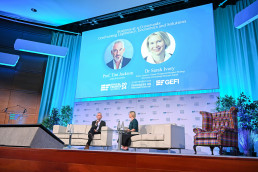
Tim Jackson is an ecological economist and writer. Since 2016 he has been Director of the Centre for the Understanding of Sustainable Prosperity (CUSP). CUSP is a multidisciplinary research centre which aims to understand the economic, social and political dimensions of sustainable prosperity. Its guiding vision for prosperity is one in which people everywhere have the capability to flourish as human beings – within the ecological and resource constraints of a finite planet.
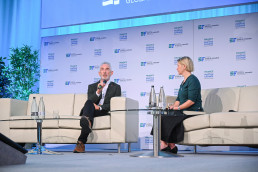
Dr. Sarah Ivory, Senior Lecturer in Executive Education at the University of Edinburgh Business School, led the fireside discussion with Professor Jackson.
Professor Jackson addressed the urgent need to redefine economics and progress to effectively tackle climate change, biodiversity loss, and inequality as well as other challenges that conventional economics has failed to resolve. He critiqued the current economic system as unstable, driven by financialisation and fixation on growth and argued that this system has led to procrastination rather than progress, with growth rates in advanced economies declining since the 1960s.
Professor Jackson advocated for reframing investment as a commitment to the future, focusing on enterprises that generate societal value rather than merely financial returns. He stressed the importance of ethical finance in the transition promoting investments advocating for investments in growth-oriented sectors like renewable energy while avoiding harmful industries. He also highlighted the need for ongoing vigilance to ensure that investments remain aligned with societal progress. The critical role individuals play in fostering change, citing figures like Wangari Maathai and Peter McCase and their dedication to ethical investment and sustainability, was mentioned during the discussion.
Professor Jackson concluded by encouraging delegated to increase their awareness of the risks posed by vested interests that prioritise growth over societal well-being.
Navigating Uncertainty
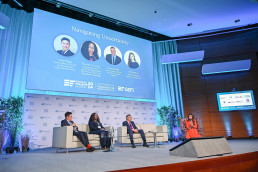

After an insightful keynote, John joined a fireside chat looking at how we can navigate uncertainty while maintaining a commitment to sustainability across different regions. The discussion was led by Amal Larhlid, Partner, PwC Middle East.
Rachel A. Aron, Managing Director, Tugo Cwiny Management Consulting started by outlining the critical global forces influencing Africa today. These include a surge of interest in its resources, often referred to as a “golden rush”, new forms of imperialism from various continents, the emergence of global sustainability standards originating outside the continent, increased regionalism and trade relations, and growing South-South cooperation among developing countries.
Opportunities for Africa are abundant. Key initiatives mentioned by Rachel included effectively implementing the African Continental Free Trade Area (AfCFTA), engaging with the expanding BRICS+ alliance, fostering inclusive industries that focus on value addition, leveraging social capital, enhancing climate change adaptation strategies, creating alternative economic livelihoods, and exploring blue economy prospects such as sustainable aquaculture and ocean energy.
Leon Kamhi, Head of Responsibility and EOS, Federated Hermes then addressed broader global trends such as the energy transition, which necessitates new investment approaches, the disruption of AI and technology, and the geopolitical tensions that highlight the need for a just transition. He outlined strategies to make development more investable in Africa, including integrating economic and social linkages into policies and investment projects, utilising a mix of public and private sector investments, addressing socioeconomic and cultural vulnerabilities, leveraging sovereign wealth funds, and tailoring sustainable finance to the African context while involving regional financial institutions.
John Pang then presented some key initiatives underway in China, highlighting that “China’s environmental policy is not a bolt on; it is a matter of survival.” Examples included China’s approach to partnerships and investments (in infrastructure such as schools, bridges, roads, airports, and ports) that have supported Africa’s development needs.
Panelists went on to discuss broader ethical frameworks, especially those of Ibn Khaldun and Adam Smith, which are essential for tackling sustainability challenges and navigating uncertainty.
Living with Uncertainty
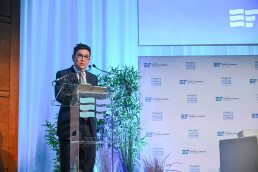
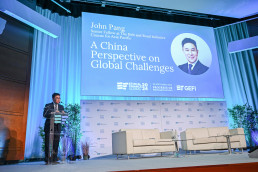
John Pang, Senior Fellow at The Belt and Road Initiative Caucus for Asia Pacific kicked off this session by delivering a keynote address drawing upon his expertise on thriving in turbulent times and China’s perspectives on global challenges. He started his keynote by discussing the importance of global cooperation and unity in addressing sustainability challenges, particularly in the context of a fragmenting world order.
“We live in a world that is increasingly decoupled, facing challenges such as multipolarity and de-globalization. Why is this relevant? Because this is not just a project in Edinburgh or a financial initiative. We are confronting a global challenge that requires collective action and unity of purpose on a scale never seen before, especially at a time when the notion of one world and one humanity is more threatened than it has been since the last great war.” John stated.
John went on to highlight China’s significant progress in reducing emissions, installing two-thirds of the world’s solar panels, reducing solar panel prices by 90% over the last decade, doubling forest cover since 1949, and planting 30 million hectares of new forest. He emphasised the importance of finding a common intellectual world, a shared understanding of information and knowledge, and reconnecting with different perspectives. John cited the historical example of the Scottish missionary James Legg, known as the ‘Dean of Chinese translators into English,’ as an example of the kind of engagement and connection needed to address global problems.
Scottish Taskforce for Green & Sustainable Financial Services Final Report Launch
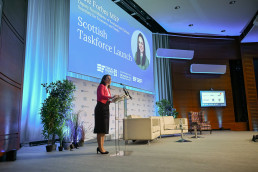
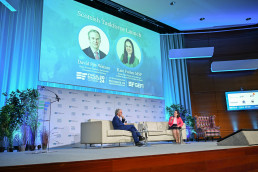
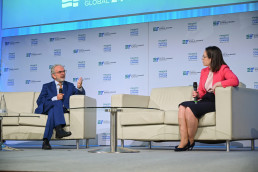

GEFI Global Steering Group member David Pitt-Watson joined Deputy First Minister of Scotland and Cabinet Secretary for Economy and Gaelic Kate Forbes to launch the Scottish Taskforce for Green & Sustainable Financial Services’ Final report.
Initiated by the Scottish Government and GEFI (secretariat) with support from Scottish Financial Enterprise (industry partner), the Taskforce was active from February 2022 until May 2024. It sought to coordinate and enhance Scotland’s sustainable finance cluster and develop its position as a leading global centre of excellence for green and sustainable finance.
With active participation from 24 financial institutions and financial services stakeholders, during its 2+ year lifespan, the Taskforce hosted 8 formal meetings, delivered 2 presentations to the First Minister’s Financial Services Growth and Development Board, facilitated over 10 workshops and conducted 50-plus private meetings.
The report includes significant and timely recommendations, such as the further development of the annual Green Finance Summit to incorporate investors and the exploration of establishing an industry-led Green and Sustainable Finance Institute.
At the Summit, the Deputy First Minister delivered a keynote address before joining Taskforce Chair David Pitt-Watson for a fireside chat. The session concluded with a video from Mark Carney, UN Special Envoy on Climate Action and Finance (available on the Taskforce website).
Some of the key insights shared during the report launch at the Summit included:
“This is a pivotal time in our journey. We know that the cost of transitioning to a net zero economy are lowest and the opportunities are greatest with early and well managed action. The Taskforce report is a routemap that will take us to that end point of success and we as society, government, and industry are accountable to rise the challenge and deliver it.” Kate Forbes MSP, Deputy First Minister of Scotland and Cabinet Secretary for Economy and Gaelic
“Today marks an important milestone. Scotland embodies what the world requires to build a sustainable future, both Smith’s invisible hand in the market with his moral sentiments of a society dedicated to sustainability combined with the innovation and pragmatic spirit of the Scots, gave rise to the Industrial Revolution and positions Scotland to lead the sustainable revolution.” Mark Carney, UN Special Envoy on Climate Action and Finance
“The GEFI team has been a huge support to the Scottish government and to the wider financial sector, promoting the global dialogue around the development of ethical finance and supporting Scotland’s ambition to become a truly competitive global centre for green and sustainable financial services.” Kate Forbes MSP, Deputy First Minister of Scotland and Cabinet Secretary for Economy and Gaelic
EF Global 2024 Welcome Remarks
This year summit kicked off with inspiring words from Omar Shaikh, Managing Director, GEFI; Thom Kenrick, Head of Social Strategy & Impact, NatWest Group; Dr. Sarah Ivory, Senior Lecturer in Climate Change and Sustainability, University of Edinburgh Business School.
The summit will feature a combination keynotes, conversations, panels and presentations covering navigating uncertainty, leadership and purpose, the transition to net-zero as well as nature and climate solution. Today we will hear from 36 speakers, who have come from Europe, Asia, Africa, and the Americas and expecting over 250 delegates to join across the day.

WANTED! An Offer to Private Finance on International Climate and Nature Finance
In May, we wrote about how 2024 is meant to be the year for international climate finance. We underlined the fact that the UNFCCC and the international climate community are sadly way behind the game on mobilizing climate finance for developing countries to tackle the dual challenges of the energy transition and climate adaptation. We also highlighted how the negotiators on the Global Biodiversity Framework (GBF) are exploring how public and private finance can be mobilized to deliver on the GBF.
This combination of public and private finance is essential if it is to be scaled up – nearly $200 trillion to reach the net-zero targets of 2050, according to a European Commission paper from earlier this year – and at the urgent pace required. However, after a meeting between climate negotiators in Baku which finished on 11 September, it’s obvious that the UNFCCC talks on finance are stuck on the key issues of the amount that needs to be mobilized (the “quantum” in negotiator speak) and which countries should be contributing (the “contributor base”, i.e. should major non-Western economies like China and Saudi Arabia be donors as well. The over-riding concern is that the goal of agreement on a New Collective Goal (NCQG) on finance at COP29 in November ends in failure. This stalemate is obviously very worrying, given its potential to derail the entire COP29 meeting in Baku in November. But we also believe that these differing views on the quantum and contributor base risk overlooking the central issue: that raising the huge amounts of international climate and nature finance required will only be accomplished by mobilizing the private sector. And for the finance to be mobilized, the private sector needs a full and comprehensive offer from policymakers that presently is not on the table.
Governments could usefully learn from how the renewables market has become a $1.3 trillion global market. This has been achieved – alongside the polluter pays principle for high-carbon energy sources - through a clear focus on the policy frameworks (mechanisms to incentivize investments in low-carbon energy sources), supported by a recognition that governments can help to de-risk those investments through strong political commitments backed-up by judicious, targeted public finance which primes the pump for private sector investment.
On nature finance, there is an equal pattern where the urgent scale up of funding is required: the biodiversity funding gap is a US$700 billion annual finance gap to fill by 2030. At COP16 next month, governments are required to present, via the National Biodiversity Strategies and Action Plans (NBSAPs), strategic plans to support the increase of finance for nature from all sources. So far, only 14 countries have submitted their updated plan: Republic of Korea; Malaysia; Suriname; Italy; Canada; Austria; Ireland; China; France; European Union; Luxemburg; Hungary; Japan; Spain.
So how can this full-throated offer to the private sector on international climate and nature finance be made? We suggest in two mutually supportive ways: through a policy re-framing, and through innovation.
The task of re-framing is probably the less problematic of the two. Central to this is about changing mindsets. At its core, we think that the entire policy community – Global North governments, the international financial institutions (IFIs) like the World Bank, the regional multilateral development banks (MDBs) – need to shift the debate (and associated differences of opinion) away from arguing about whether individual countries should be a donor. Instead, there needs to be an acknowledgment that: a) some of the BRICS heavyweights such as China and Brazil are paying into climate finance support via their contributions to the IFIs and the MDBs, and also through bilateral support, eg China’s support for climate-related projects in Africa; and b) while public finance is obviously key to incentivizing private sector investment, in the final analysis, it is private finance which will change the game at scale on financing the transition. Pivoting in this way to a partnerships framing – North/South in parallel with public/private - can, we feel, unlock international co-operation and supersede the zero-sum situation.
This takes us on to the second complimentary approach: a concentration on innovative sources of finance. So many ideas of how and where to mobilise private finance have been floated. In summary, we see these ideas boiling down to a three-part offer:
- First on subsidies, where we make no apology for consistently advocating this theme. Carbon Tracker recently made a strong case for international subsidy reform, predicated on moving government support away from fossil fuel production. A shift in this policy area – which requires comprehensive backing across the international spectrum, combining the political (UN, G20, IEA and regional groupings like the EU) with the economic (World Bank, IMF, the MDBs) – would send a powerful signal to the private sector that they can with confidence fall in behind Article 2.1.c of the Paris Climate Agreement (the objective to shift financial flows from high-carbon to low-carbon energy sources.) Subsidy reform should be top of the policy agenda for the Brazilian Government, as it assumes not only the BRICS chairmanship in 2025, but the Presidency of the all-important COP30 in November 2025. Equally, nature would strongly benefit from a reduction of governmental environmental harmful subsidies (EHS). Target 18 of the GBF, the first quantitative reduction goal for EHS, commits to reduce environmentally harmful subsidies by $500 billion annually by 2030. While research shows the scale of subsidies continues to rise, greater effort is expected by governments. Of course, subsidy reform at the global level is hardly a new concept – but a multi-stakeholder approach bringing together the international political and economic decision-making institutions would be something new;
- Second, a concerted international focus on debt in developing countries could also have a transformative effect on the investment environment for private finance in the Global South. An initiative on debt would also have the benefit of tackling climate and nature finance, given that it is a common obstacle to scaling up private finance in both areas. The debt crisis in itself is crying out for an innovative approach. Think-tanks such as the World Economic Forum as well as Planet Tracker have written extensively about innovative financing models for debt-for-climate and debt-for-nature swaps. Indeed, debt-for-nature swaps - where a country receives debt relief in exchange for committing to protect its forests – have been around for some years. Debt-for-climate swaps have been less utilized; but the principle, which could also be broadened to encompass the energy transition so that a government benefits from concessional finance for decarbonization commitments, is the same. There are question marks about how much finance, debt solutions would raise. But imaginative and urgent policy development around debt could unquestionably serve to create a more favourable investment environment in Global South countries;
- Last, a private sector offer which genuinely leverages private finance innovation. Carbon Tracker and Planet Tracker engage regularly with investors and we know the scope for innovative thinking which resides in the sector. One such example is the insurance industry, who were early movers on pricing in climate and nature risk. Whether multilateral frameworks such as the UNFCCC and UN Convention on Biological Diversity have the flexibility to incorporate private finance into the NCQG process and complimentary processes is uncertain; however, the urgency of the twin crises surely requires a fresh partnership approach to incorporate innovation from private finance and investment sectors.
We suggest these channels be complimented by role modelling good practice disclosure and case studies of innovative sources of finance used to attract capital into and from private sector organizations willing to invest their resources into renewables. This can provide a roadmap and impetus for other organizations to compete through innovation.
In conclusion, the platform for international climate and nature finance needs to be de-risked, so that it can foster the low-interest rate investment climate for emerging market and developing economies, which is essential if the private sector is to make a transformative difference. A policymaker offer grounded in a new partnership approach and in innovative thinking – and which in the first instance requires a pivot in how governments publicly communicate their needs and priorities – could also help to rebuild the trust between the developed and developing world on finance. As the faltering NCQG negotiations are demonstrating, the climate of trust between Global North and Global South countries remains seriously eroded – this situation needs to be turned around fast.
This guest blog was written for the GEFI Insights Series by Richard Folland, Carbon Tracker Initiative

Transition Today
How can investors address the causes and impacts of climate change?
Investment decision-making, both today and longer term, includes addressing whether running “green portfolios” to respond to the transition to a net-zero economy can help manage investment risk and opportunity and mitigate the effects of global warming.
At the same time, the physical damages wrought by climate change – with extreme floods, droughts and wildfires now the norm in many regions – are already influencing investment and insurance decision-making, triggering a growing recognition of the importance of adaptation action to increase climate resilience.
This points to the need for a broader definition of the climate transition. This should be one that expands beyond carbon reduction to address the issues of nature loss, physical risks and adaptation. Any definition should also encompass engagement in the circular economy and support for the principles of equality for sustainable development.
An evolved definition of transition
An evolved definition of transition would seek to broaden investment approaches beyond carbon-reduction objectives, considering and incorporating solutions for both mitigation and adaptation to the physical risks of climate change.
Investors typically establish interim and 2050 science-based targets. Increasingly, such targets recognize that natural capital is critical for both mitigation efforts and combatting climate change. We observe that an increasing number of investors are seeking to integrate considerations of natural capital into investment research and analysis to help prevent nature loss and build out solutions. A circular economy supports these aims by encouraging investor allocations to companies that enable maintenance of finite resources. A “fair-share carbon budget,” which allocates the global carbon budget in a manner perceived to be equitable and fair across different countries, is also a key component of transition.
Expanding the definition
The infographic below presents an expanded view of climate transition, comprising five interrelated issues. Its process is iterative to allow for a better assessment of transition.
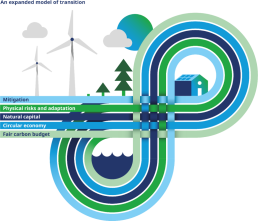
Transitioning to a net-zero economy
A more holistic approach expands the focus from carbon reduction and mitigation to encompass physical risks and adaptation, natural capital, supporting a circular economy, and the principles of equality and sustainable development in capital allocation.
To ease the transition to a net-zero economy, investors can use portfolio tools such as Mercer’s Analytics for Climate Transition (ACT). They can focus on manager and strategy selections that prioritize a wider set of transition risks and opportunities. And they can report progress using the frameworks provided by the Task Force on Climate-Related Financial Disclosures (TCFD) and the Task Force on Nature-Related Financial Disclosures (TNFD).
As case studies show, further key steps include making the following investment decisions:
- Assess each portfolio’s transition capacity.
- Identify areas of higher transition risk.
- Identify engagement priorities.
- Set portfolio-level targets across decarbonization, exposure to green transition-aligned solutions and engagement activities.
- Align capital allocation with the advice of the International Sustainability Standards Board, TCFD and TNFD. This should be done when selecting and assessing portfolio companies in relation to social and environmental issues. Resource-use issues including (but not limited to) carbon and emissions should also be considered.
- Develop TCFD and TNFD reporting.
- Undertake reporting commitments as part of net-zero, nature and circularity initiatives.
- Review investment manager progress on climate mitigation and adaptation, nature, and circularity issues.
- Set sub-portfolio targets.
- Review proposed benchmark changes for sustainability and climate-aligned indices for index-tracking equity and credit portfolios.
This guest blog was written for the GEFI Insights Series by Helga Birgden, Mercer, and Sarika Goel, Mercer.