
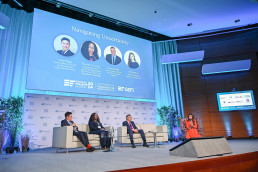
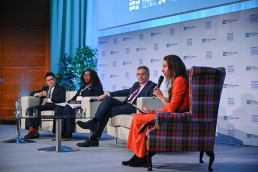
After an insightful keynote, John joined a fireside chat looking at how we can navigate uncertainty while maintaining a commitment to sustainability across different regions. The discussion was led by Amal Larhlid, Partner, PwC Middle East.
Rachel A. Aron, Managing Director, Tugo Cwiny Management Consulting started by outlining the critical global forces influencing Africa today. These include a surge of interest in its resources, often referred to as a “golden rush”, new forms of imperialism from various continents, the emergence of global sustainability standards originating outside the continent, increased regionalism and trade relations, and growing South-South cooperation among developing countries.
Opportunities for Africa are abundant. Key initiatives mentioned by Rachel included effectively implementing the African Continental Free Trade Area (AfCFTA), engaging with the expanding BRICS+ alliance, fostering inclusive industries that focus on value addition, leveraging social capital, enhancing climate change adaptation strategies, creating alternative economic livelihoods, and exploring blue economy prospects such as sustainable aquaculture and ocean energy.
Leon Kamhi, Head of Responsibility and EOS, Federated Hermes then addressed broader global trends such as the energy transition, which necessitates new investment approaches, the disruption of AI and technology, and the geopolitical tensions that highlight the need for a just transition. He outlined strategies to make development more investable in Africa, including integrating economic and social linkages into policies and investment projects, utilising a mix of public and private sector investments, addressing socioeconomic and cultural vulnerabilities, leveraging sovereign wealth funds, and tailoring sustainable finance to the African context while involving regional financial institutions.
John Pang then presented some key initiatives underway in China, highlighting that “China’s environmental policy is not a bolt on; it is a matter of survival.” Examples included China’s approach to partnerships and investments (in infrastructure such as schools, bridges, roads, airports, and ports) that have supported Africa’s development needs.
Panelists went on to discuss broader ethical frameworks, especially those of Ibn Khaldun and Adam Smith, which are essential for tackling sustainability challenges and navigating uncertainty.