The Edinburgh Finance Festival returned from 8–20 June 2026, building on the success of its inaugural edition. Held in September 2025, the first Festival welcomed over 3,000 participants across 25 events, uniting professionals, policymakers, and academics committed to advancing the future of finance.
About
The 2026 Festival once again convened a number of partners to deliver a dynamic programme of curated events designed to celebrate progress, inspire innovation and catalyse meaningful change across the financial system.
Marking the 250th anniversary of The Wealth of Nations, the 2026 Festival included events that revisit Adam Smith through a 21st-century, post-hegemonic lens, not to celebrate him uncritically, but to interrogate and reimagine his legacy. By recovering what has been lost, adding voices beyond the Western canon and engaging with emerging global perspectives, the Festival invites a fresh reflection on what markets are for, whom they serve and the moral responsibilities they must uphold today.
More than just a conference, the Festival draws on Edinburgh’s cultural and intellectual heritage spanning over 300 years, reinforcing the city’s role as a global hub for collaboration and creative inquiry.
Building on the momentum of its first year, which featured three major flagship events alongside roundtables and workshops, the 2026 edition broadened its reach and ambition, offering an expanded platform for dialogue and collective action as we shape Finance for All.
Why Edinburgh?
With Scotland’s rich heritage in financial services and its reputation as the natural home for green and sustainable finance and a global Fintech hub, Edinburgh provided the perfect setting for the festival.
Its legacy of the macro and systemic thinking, paired with a contemporary culture of inquiry and world-renowned cultural assets, created a unique environment for innovation and inspiration.
The Festival positioned Scotland not just as a host, but as a global thought broker in finance.

Dame Susan Rice, Chair, GEFI Global Steering Group
“This year’s programme will once again bring together brilliant minds across finance, technology, and energy to drive meaningful action on climate change, social equality, and sustainable growth.”

Aleks Tomczyk, Chief Executive, FinTech Scotland
“As Scotland’s fintech cluster body connecting 260+ innovators with industry, academia and the public sector, FinTech Scotland is delighted to support a platform that strengthens Edinburgh and Scotland’s position as a global centre for responsible and ethical finance.”

Tanya Retter, Chief Executive, Chartered Banker Institute
“As the Chartered Banker Institute continues to champion professionalism and responsible banking worldwide, we welcome the Edinburgh Finance Festival as a valuable platform for dialogue and collaboration.”
Media Coverage



Hear from GEFI’s Managing Director, Omar Shaikh on what delegates can expect from this year’s festival and how to get involved.
FLAGSHIP EVENTS
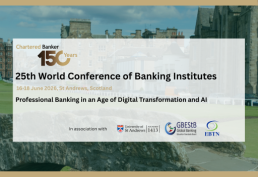
The World Conference of Banking Institutes
The 25th World Conference of Banking Institutes came to in Scotland from 16-18 June 2026 — a global gathering of banking professionals, educators, and thought leaders.
Organised by the Chartered Banker Institute, which is celebrating 150 years, and set against the historic backdrop of St Andrews, the conference explored how digital transformation and artificial intelligence are reshaping professional banking and the skills needed for the future.
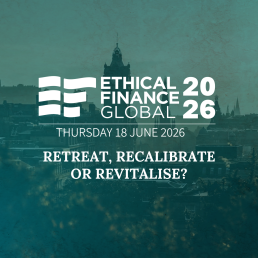
Ethical Finance Global 2026
Global financial leaders, policymakers, academics and practitioners once again gathered in Edinburgh for Ethical Finance Global. The 2026 edition, taking place on Thursday 18 June 2026, explored how the debate has evolved beyond a simple choice between retreat or revitalisation.

SDG Hive
On Wednesday 17 June 2026, the SDG Hive programme held a series of private roundtables where senior FS professionals and policy leads joined for interactive discussions on key industry challenges.
Past Events:


In 2016, faith groups came together in Edinburgh to establish a shared values framework, resulting in the Edinburgh Finance Declaration. A decade on, this session examined how those principles have translated into practical solutions.
We also turned to Islamic finance, the largest segment of faith-based finance, to explore both global and local perspectives. Should the terminology evolve? And what can different faith traditions learn from one another in advancing ethical finance?

Global financial leaders, policymakers, academics and practitioners will once again gathered in Edinburgh for Ethical Finance Global. The 2026 edition, which took place on Thursday 18 June 2026, explored how the debate has evolved beyond a simple choice between retreat or revitalisation.
The 25th World Conference of Banking Institutes was hosted in Scotland from 16-18 June 2026 — a global gathering of banking professionals, educators, and thought leaders.
Organised by the Chartered Banker Institute, which is celebrating 150 years, and set against the historic backdrop of St Andrews, the conference explored how digital transformation and artificial intelligence are reshaping professional banking and the skills needed for the future.
This pioneering new short documentary highlights small island leadership on climate action, ocean governance and development finance, showcasing how Small Island Developing States (SIDS) are driving global conversations on resilience and reform.
The screening took place in Edinburgh’s world-class science museum and planetarium, and was followed by a short discussion featuring the filmmakers and invited speakers, alongside a networking reception and an opportunity to visit Dynamic Earth’s exhibits.
This private dinner brought together policymakers, financial institutions, and project developers to discuss Scotland’s energy transition priorities and investment opportunities.
The conversation explored how government, finance and industry can work together to strengthen energy security, enhance system resilience, and support industrial regeneration across Scotland. The evening was designed to encourage open and practical dialogue and will be held under Chatham House Rules.

GEFI and Carbon Tracker co-hosting a roundtable to discuss how systemic climate risks are assessed within TCFD reporting, the triennial valuation processes and effectively governed by LGPS funds, building upon recent reports by the IFOA, Carbon Tracker and University of Exeter.
It was intended as a peer forum, giving practitioners the chance to compare approaches, share lessons and explore what can be influenced within the LGPS and across devolved and UK Government.
The roundtable opened with remarks and presentations followed by an interactive discussion moderated by Carbon Tracker.
As part of the Edinburgh Finance Festival, DBT Scotland convened a single-day programme of three linked engagements at the Scotland Office Cabinet Room, Queen Elizabeth House, designed to showcase Scotland’s strengths in international investment, Asia engagement and sustainable finance. The programme created a high-level platform to connect global investors and institutional capital with Scotland’s wider economic and sustainability priorities.
This session’s purpose was to:
- Convene Asia-linked investors, city leaders and financial stakeholders
- Position Scotland within broader Asia-facing investment and finance networks
- Bridge international engagement between the HK visit and finance discussions
For further information, please contact chris.tait@businessandtrade.gov.uk
On Wednesday 17 June 2026, the SDG Hive programme held a series of private roundtables where senior FS professionals and policy leads join for interactive discussions on key industry challenges.
As part of the Edinburgh Finance Festival, DBT Scotland convened a single-day programme of three linked engagements at the Scotland Office Cabinet Room, Queen Elizabeth House, designed to showcase Scotland’s strengths in international investment, Asia engagement and sustainable finance. The programme created a high-level platform to connect global investors and institutional capital with Scotland’s wider economic and sustainability priorities.
This session’s purpose was to:
- Showcase Scotland and its clean energy strengths
- Establish and/or improve bilateral relationships
- Identify collaboration opportunities
For further information, please contact chris.tait@businessandtrade.gov.uk

Join us for a forward looking breakfast session that puts the future of the finance profession centre stage.
This session is part of the 2026 Edinburgh Finance Festival programme and is set to be a must attend conversation for anyone shaping, leading, or influencing the profession.
Our panel will bring together senior voices from across the sector to explore how the skill sets required of finance professionals are rapidly evolving. Expect a dynamic discussion covering how the following will impact on skills:
- Society’s expectations of accountants in the future
- Technology and the accelerating impact of AI on ethical leadership and public trust
- Sustainability and the shift to a net zero economy
- What education and skills providers must do now to prepare future talent
As a named partner of the Edinburgh Finance Festival for the second year running, ICAS is proud to lead this conversation at a pivotal moment for the profession.


Fraud is often framed as a technical or compliance issue. This session, sponsored by global accountancy body ACCA, argued it is something deeper: a visible symptom of ethical, cultural and governance weakness within financial systems.
Drawing on ACCA’s Combatting Fraud in a Perfect Storm research and the Risk Culture Series, Rachael Johnson explored how AI, complexity, weak accountability and information overload are reshaping fraud risk. Through themes such as compliance theatre, the triage trap and escalation asymmetry, the session showed why fraud is one of the clearest practical tests of whether ethical finance is real or rhetorical.
Joining the session, Vera Cherepanova brought a complementary governance and ethics lens, drawing on her work on how boards oversee ethics and the critical question of “Who’s Watching the Board?”. Together, the session explored not only how fraud emerges, but what it reveals about board effectiveness, ethical leadership and accountability at the highest level.
The discussion connected fraud, risk culture and ethics to the practical realities faced by boards, investors and governance professionals and what must change to move from compliance frameworks to genuine ethical infrastructure. Central to this is the role of curiosity – how to operationalise it, professional scepticism and the courage to ask better questions – how to challenge assumptions, interrogate what is not being said, and create the conditions where difficult issues are surfaced early rather than explained away.
The thought-provoking session combined insight, challenge and practical reflection for professionals navigating today’s complex geopolitical and economic environment.

The roundtable considered how projects including green energy, regeneration and public infrastructure can create social, environmental and economic benefits, rather than just financial returns. The session looked at various state-backed investment vehicles and the impact they aim to make and the opportunities for private capital to collaborate.

The University of Edinburgh Business School launched a new course to help organisations understand the impact of climate shocks on credit risk and loans. Targeted at credit risk modellers, managers and other finance professionals, the course will help to:
- learn how and why to use climate scenarios and stress testing methods
- integrate climate-related and financial risks into credit risk models
- evaluate resilience
- understand data for transition and physical risk.
The course is led by Professor Raffaella Calabrese from the Business School, and Dr Joe Breeden the Chief Executive Officer at Deep Future Analytics, and is based on our pioneering research into climate stress testing.

2026 is a landmark year for our business. In March, we completed our name change from Phoenix Group to Standard Life plc.
On Thursday 11 June, we welcomed guests from across politics, business and the media to an evening of celebration, marking this exciting next chapter for Standard Life, and our enduring connection to Scotland and Edinburgh.
The Social Enterprise Academy delivers the Social Enterprise Schools Programme across Scotland and invited businesses within the ESES City Region to the Celebrating Young Changemaker Awards on Monday, 8 June, 10 am–2 pm, at the Edinburgh International Conference Centre. Reserve your space here.
Rooted in a pupil‑led approach and guided by experienced social entrepreneurs, the programme empowers young people to design and run their own social enterprises, building confidence, leadership, entrepreneurial mindset, financial literacy and real social impact.
Watch their short film to see Scotland’s next generation of social entrepreneurs in action.
This event celebrated pupil‑led social enterprises and the meaningful change young people are already delivering in their communities. These pupils are not just the changemakers of the future; they are already leading the way.
The Social Enterprise Schools Programme is enabling young people across the globe to create real, lasting impact, and this event brings their achievements to life.
Attending the festival offered delegates opportunities to gain insights into the latest industry trends, discover innovative financial solutions, expand professional networks, and experience the warm Scottish hospitality.
Anchor Partners

Festival Partners