
Hosted by Martin Currie, our Festive Fireside wrapped up 2024 an unwrapped 2025 with Amanda Young, GEFI, and Euan McVicar, Crown Estate Scotland.
Ethical Finance Round Table
Based in Edinburgh, the award-winning Ethical Finance Round Table series is the longest-running platform in ethical finance, bringing together the leaders in the field to enable learning and build community. Since establishing the series in 2010, we have seen opportunities flourish amongst the participants in the Round Tables. The Ethical Finance Round Table Series is currently being held virtually.


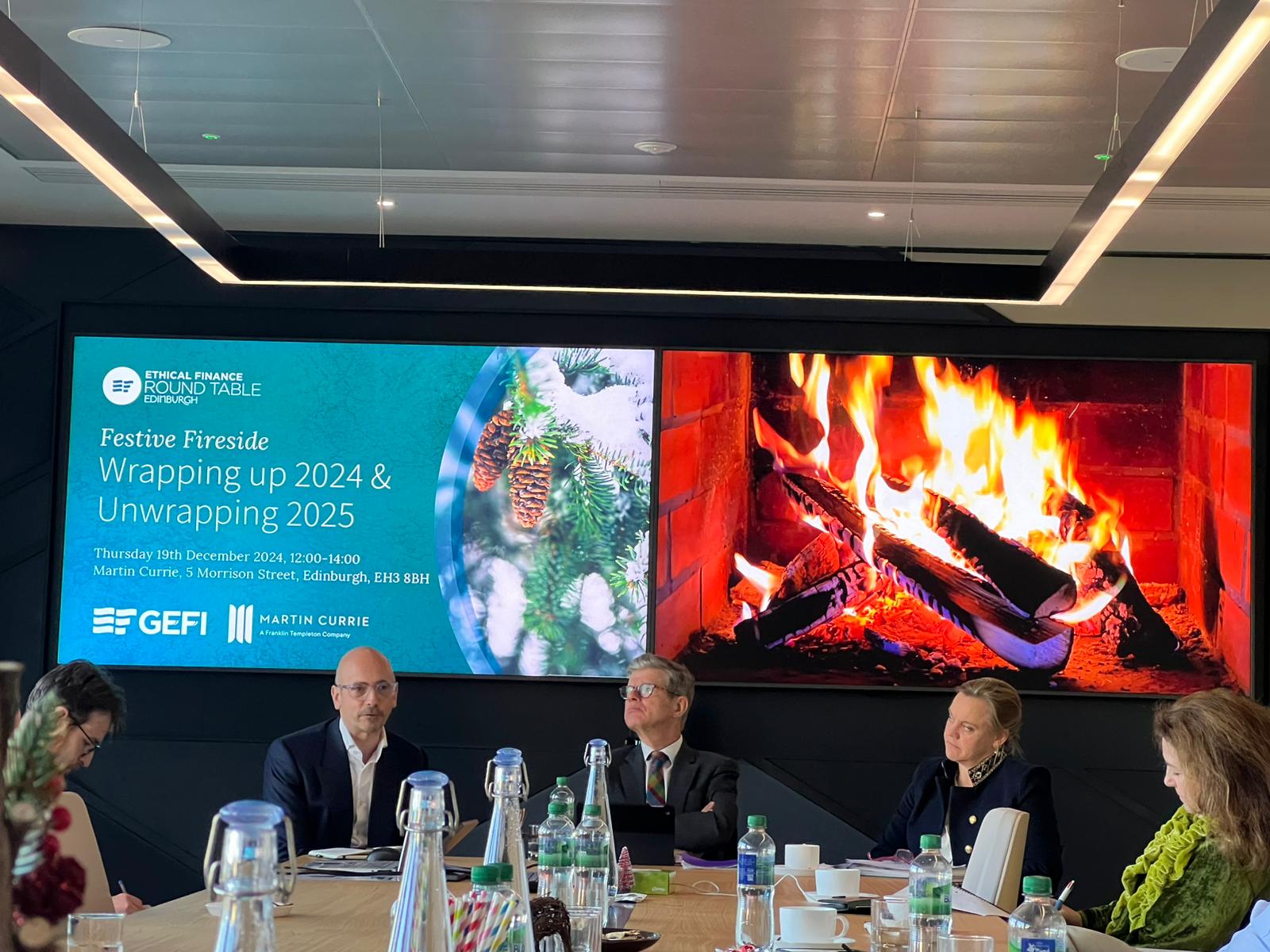
As the year draws to a close, we gathered for a festive fireside roundtable discussion, hosted by Martin Currie, to reflect on the ethical finance and sustainability landscape in 2024 and explore the road ahead. Despite the challenges faced this year, the discussion left us with a sense of optimism for the future and a renewed commitment to advancing sustainable finance globally.
The 33rd EFRT was chaired by Graham Burnside, Senior Advisor, GEFI, and attended by senior representatives from the Castle Community Bank, David Hume Institute, Ethical Futures, Forth Green Freeport, Heriot-Watt University, Mercer, Napier University, NatWest, Scottish Enterprise, Scottish Financial Enterprise, U.S Consulate General, University of Edinburgh and Wood.
Key discussion points that were covered during the interactive and dynamic session have been summarised below.
2024 Year in Review
The roundtable began with a review of 2024, highlighting the remarkable resilience of the sustainability industry in the face of significant challenges. While the passion to “do the right thing” remains strong, the year posed serious challenges for the sector:
- Regulatory Pressures: Although the merits of regulation were cited, particularly toward ameliorating greenwashing, the growing burden of compliance with frameworks like SDR, SFDR, CSRD, and ISSB have created hurdles, especially for smaller players.
- Political Instability: Global instability and a perceived lack of focus at COP28 added to the complexity, although the event remains an essential platform for dialogue.
- Continued Innovation: Amid these challenges, advances in areas like carbon credits and peatland restoration showcased the sector’s creativity and determination.
Concluding her market update, Lauran Halpin, Head of Impact Equities at Martin Currie, highlighted the financial sector’s potential to drive systemic change, emphasising the importance of legislative progress and robust disclosure frameworks to support sustainability efforts.
Crown Estate’s Sustainability Approach
Euan McVicar, Chair of Crown Estate Scotland, outlined its role as an impact investor dedicated to sustainable development. He detailed the Crown Estate’s extensive assets in Scotland, including 50% of Scotland’s foreshore, over 35,000 hectares of land, and significant seabed holdings, highlighting their plans to decarbonise the estate and address climate change risks. Euan also reflected on the estate’s rich history and its pivotal role in driving sustainable practices across its operations.
Scotland’s Sustainable Finance Opportunity
A key theme of the discussion was Scotland’s unique potential to lead in sustainable finance. The recently launched report from the Scottish Task Force for Green and Sustainable Financial Services provides a roadmap to making Scotland competitive in green investment. However, participants highlighted areas where Scotland must improve:
- Coordinating Ecosystems: Scotland needs stronger connections between its universities, financial institutions, and innovative companies.
- Prioritising Recommendations: With numerous recommendations in the Task Force report, focus and decisive action are critical.
- Decisive Government Action: Hesitancy in offering corporate incentives and public pushback on certain policies have slowed progress.
Scotland’s academic excellence, natural resources, and financial heritage position it well for leadership in sustainable finance, but better coordination and bold policy decisions are needed to capitalise on these strengths.
Outlook for Sustainability in 2025
The discussion explored global sustainability in the context of the incoming U.S. administration, highlighting both optimism and concerns regarding the future of climate policies, particularly the U.S.’s potential exit from the Paris Agreement and UNFCCC framework. Despite these uncertainties, participants expressed confidence that market forces would sustain progress. Economic drivers such as the growth of renewables and electric vehicles, bolstered by the Inflation Reduction Act (IRA), have already created jobs and economic benefits that are challenging to reverse. State-level actions, with climate leaders like California and New York, often surpass federal initiatives, and even states like Texas are making significant contributions, responsible for one-third of on-shore wind capacity.
Additionally, global market forces, including EU regulations, are pushing U.S. companies to align with sustainability standards to maintain access to international markets. Together, these factors indicate that the momentum for sustainability is likely to persist, even in the face of reduced federal support.
Key takeaways
The Round Table provided an interactive forum for leaders and experts to reflect on 2024 that underscored the resilience of the sustainability movement and look to 2025 that offers an opportunity to build on this foundation. By staying agile, collaborative, and bold, we can continue driving meaningful progress in ethical finance and sustainability.
- Despite significant regulatory and political challenges in 2024, the sustainability industry showcased resilience, innovation, and a steadfast commitment to driving systemic change.
- Scotland can lead in sustainable finance but needs better coordination, prioritised actions, and bold government support.
- Despite political uncertainties, strong economic drivers, state-level actions, and global market forces are expected to sustain momentum for sustainability in 2025.