
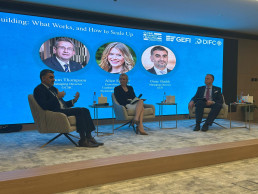
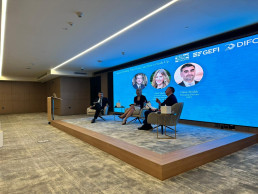
The GCBC Forum’s focus shifted to the foundations of effective capacity building as Simon Thompson opened a fireside conversation with Alice Spencer, Interim Executive Director of Education at the Cambridge Institute for Sustainable Leadership (CISL), and Omar Shaikh, Managing Director of the Global Ethical Finance Initiative (GEFI). Their dialogue explored what truly works in helping individuals, institutions, and ecosystems translate knowledge into meaningful climate finance actions.
Defining Success Before Numbers – Alice Spencer (CISL)
Alice acknowledged the difficulty of measuring the real-world impact of capacity building, noting that mindset shifts and behavioural changes are often hard to quantify. She stressed the importance of setting clear objectives from the outset. Rather than focusing solely on the number of people trained, CISL tracks how effectively participants adapt business models, strategies, or policies as indicators of genuine progress. Moving beyond individual training, CISL has embraced scalable online programmes and peer networks to foster ongoing learning and collaboration.
An Ecosystem Approach – Omar Shaikh (GEFI)
Omar reinforced the need for a holistic perspective. Capacity building, he explained, must be integrated with an enabling regulatory environment and the development of concrete financial products and solutions. This ensures that knowledge is not abstract but directly linked to practical application. Omar highlighted the importance of fostering a shared understanding among stakeholders before launching training initiatives, tailoring interventions to local contexts, and encouraging broader, more strategic discussions around the purpose of sustainability rather than focusing solely on technical details.
Broader Perspectives and Purpose
Both speakers agreed that while technical knowledge is essential, mindset and capability shifts drive transformational change. Faith-based finance, such as Islamic finance, can enrich these efforts by bringing valuable perspectives on ethical, social, and community-focused dimensions—often the overlooked “S” in ESG.
Looking Ahead
Asked for one piece of advice to newcomers in the climate finance arena, Alice advocated nurturing curiosity and maintaining a hopeful vision, while Omar encouraged engaging in selective forums and team-based learning to strengthen collective capacity.
Key Takeaways
- Set Clear Goals: Define desired outcomes beyond participant numbers to ensure capacity building leads to tangible changes.
- Integrate Across Systems: Align training with policy, regulation, and product development for lasting impact.
- Foster Mindset Shifts: Go beyond technical knowledge to embrace philosophical and strategic dimensions of sustainability.
- Leverage Diverse Perspectives: Incorporate insights from faith-based finance and other communities to enrich understanding.
- Invest in Ongoing Learning: Use scalable platforms, peer networks, and collaborative forums to sustain engagement and growth.
By marrying technical knowledge with purpose-driven dialogue, capacity building can transcend mere instruction and become a catalyst for the systemic transformation needed to mobilise climate finance at scale.