
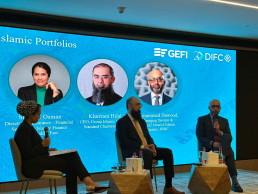
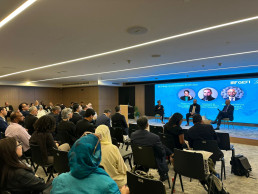
The second fireside chat moderated by Shereen Osman of PwC Middle East brought to light the unique opportunities and challenges in building green Islamic portfolios. The discussion featured insights from Khurram Hilal of Standard Chartered and Mohammed Dawood of HSBC, both leaders in the field of Islamic and sustainable finance.
Aligning Islamic Finance with ESG Goals
Mohammed Dawood emphasized that the principles of Islamic finance naturally align with Environmental, Social, and Governance (ESG) objectives. He highlighted HSBC’s pioneering efforts in issuing green Sukuk since 2018, underscoring the bank’s commitment to sustainability. Dawood stressed that Islamic finance should play a leading role in financing real economy and infrastructure projects, leveraging its ethical foundations to drive sustainable development.
He also pointed out the importance of industry bodies in setting standards and providing direction. “Building capacity and thought leadership within the industry is crucial,” Dawood remarked. He called for greater collaboration among financial institutions to expand the impact of Islamic sustainable finance.
Standard Chartered’s Approach to Sustainable Islamic Finance
Khurram Hilal shared how Standard Chartered is integrating sustainability into its Islamic finance offerings. He noted that the “do no harm” ethos inherent in Islamic finance is intrinsically connected to ethical and sustainable practices. Hilal highlighted the growing interest from clients, especially younger generations, in products that combine Islamic and sustainable finance principles.
Standard Chartered’s global commitment to sustainability includes the Global Islamic Finance Program (GIFP), an initiative aimed at incubating sustainable projects. Hilal emphasized the need for both institutional support and customer demand to drive the industry forward. “It’s about creating a push and pull effect,” he said, “where institutions offer sustainable products, and customers actively seek them.”
Challenges and the Role of Regulators
Both speakers acknowledged challenges in aligning Islamic finance with sustainability goals. A significant hurdle is the need for more talent and expertise in this niche field. They also discussed the critical role of regulators and industry bodies in promoting sustainable Islamic finance. Proactive government initiatives, such as those associated with COP28 in the UAE, are seen as positive steps toward fostering growth.
“Building trust and credibility is essential,” Dawood stated. Hilal agreed, adding that transparency and clear standards are vital for the industry’s advancement. They highlighted that while progress is being made, there is still much work to be done to fully integrate sustainability into Islamic finance practices.
The Path Forward: Islamic Finance Leading in Sustainability
The discussion concluded with a shared vision for Islamic finance to take a leading role in global sustainability efforts. Both Dawood and Hilal called for the industry to increase its share beyond the current 5% of sustainable finance. By leveraging its ethical principles and focusing on financing projects that have tangible environmental and social benefits, Islamic finance can significantly contribute to addressing global challenges.
“Islamic finance has the potential to be a powerful force for good,” Hilal asserted. Dawood echoed this sentiment, emphasizing that collaboration and innovation are key to unlocking this potential.
Key Takeaways
- Natural Alignment: Islamic finance principles inherently support ESG and sustainability goals.
- Industry Leadership: Banks like HSBC and Standard Chartered are pioneering efforts to integrate sustainability into Islamic finance.
- Collaborative Effort: Building green Islamic portfolios requires collaboration among institutions, regulators, and customers.
- Challenges Ahead: Talent gaps and the need for clear standards are hurdles that must be addressed.
- Future Potential: With proactive efforts, Islamic finance can lead in financing sustainable projects, amplifying its impact on global sustainability.