


One of the final SDG Hive sessions was delivered in partnership with UN Global Compact Network UK and the Principles for Responsible Investment.
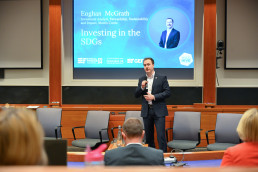
Billy Armstrong, Project Manager of the UN Global Compact Network UK, introduced the Sustainable Finance Collaboration Lab and highlighted the crucial role of businesses in advancing the Sustainable Development Goals (SDGs). As the 2030 deadline looms, the urgency to accelerate progress is intensifying, with recent reports showing that only 17% of the SDGs are on track. This stark reality highlights the need for swift, coordinated action from businesses, governments, and financial institutions to turn the tide.
Billy began by outlining the mission of the UN Global Compact, which is to encourage businesses worldwide to adopt sustainable and socially responsible policies. The Global Compact’s four key focus areas—human rights, environmental sustainability, labour practices, and anti-corruption—are underpinned by the SDGs framework, which serves as a roadmap towards a more sustainable and equitable future. Finance, Billy emphasised, is a critical lever for progress across all 17 SDGs, not only to strengthen financial systems but also to build resilience in an interconnected and increasingly volatile global economy.
As businesses represent around 70% of global GDP, their role in driving the SDGs cannot be overstated. Billy highlighted that finance is not just a tool for growth but a transformative force capable of aligning business practices with the broader goals of sustainable development. He noted that while some progress has been made, the world is still falling behind, and there is an urgent need to channel more financial resources into projects and initiatives that directly contribute to SDG achievement.
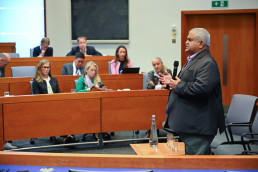
Satya Tripathi, former Assistant Secretary-General of the UN, then delivered an opening keynote and underscored the persistent issue of follow-through in international gatherings, particularly at the United Nations (UN). While these convenings aim to foster substantial agreements among member states, the diverse perspectives and expectations of nearly 200 countries often result in vague outcomes that fail to translate into actionable results. This phenomenon is prevalent across various global Initiatives, including the Sustainable Development Goals (SDGs). Satya illustrated the importance of creating effective narratives to mobilize resources and action. For instance, a project in Indonesia secured $400 million for forest conservation without any government funding, demonstrating that private investments can successfully support environmental initiatives when framed effectively. Similarly, in India, a shift toward sustainable farming has begun, funded by the German Development Bank, showcasing the potential of collaborative efforts between the public and private sectors.
Moving forward, there is a call to action to focus on practical solutions that foster local empowerment rather than getting bogged down in financial metrics alone. The ambitious goal of creating 10 million green entrepreneurs exemplifies this vision, aiming to equip communities with the tools and resources necessary to drive sustainable change. By emphasizing collaboration, innovation, and community ownership, the speaker believes that meaningful progress in sustainable finance can be achieved, ultimately leading to positive outcomes for both the environment and local economies.
The panel discussion moderated by Jessica Attard, Deputy Director, Cambridge Institute of Sustainable Leadership covered the role of partnerships in advancing finance for the SDGs. The discussion focused on the challenges of alignment within the financial system, such as misaligned time horizons, risk-reward ratios, and management incentives. Panellists shared examples of initiatives and partnerships aimed at addressing these challenges, including PRI’s collaborative stewardship initiative, capacity-building programs, and engagement with policymakers. The panel also discussed the importance of scaling private finance into emerging markets and addressing the adaptation finance gap. Panellists highlighted the need for capacity building, knowledge sharing, and leveraging partnerships with development banks and other stakeholders to mitigate risks and unlock investment in these regions. The discussion touched on the role of policy and reporting frameworks in promoting positive outcomes and driving systemic change. Panellists shared insights on the challenges of reporting requirements and the need for alignment between corporate positions and lobbying activities. They also discussed the importance of engaging with policymakers to create an enabling environment for sustainable finance and long-term investment.
A key highlight of the session was the interactive collaboration lab, where participants engaged in breakout discussions to share their experiences, challenges, and insights. These discussions fostered a spirit of collaboration, with participants recognising the value of collective action in addressing global issues. By bringing together diverse perspectives, the lab encouraged new ideas and solutions, demonstrating that partnerships are essential for navigating the complex landscape of sustainable development.
With less than six years left until the 2030 deadline, the session underscored that time is of the essence. The financial sector has a unique opportunity to lead the charge, leveraging capital and expertise to create a more sustainable future. By collaborating across sectors and borders, businesses, investors, and governments can ensure that the SDGs are met, securing prosperity for current and future generations.
The session closed with a call to action: finance must be at the forefront of the global effort to achieve the SDGs. The collaboration between the UN Global Compact, GEFI, and PRI serves as a blueprint for how collective action and partnerships can create meaningful impact. The path ahead is challenging, but with finance as a catalyst for change, a sustainable and equitable future is within reach.