

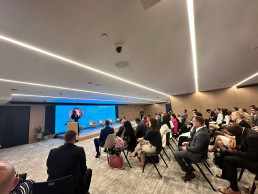
Luma Saqqaf, Director for the Middle East, Africa, and India at the Principles for Responsible Investment (PRI), delivered a deeply informed keynote addressing the challenges of financing climate action in emerging markets as. Her remarks painted a detailed picture of the immense financing gap that stands between ambitious climate targets and the reality on the ground.
Luma cited the High-Level Experts Group on Climate Finance’s staggering estimate of $6.7 trillion needed annually to advance global climate action—of which emerging markets alone require $2.4 trillion. Yet, current climate finance flows fall far short, hovering around $1.5 trillion globally, with a mere 15% reaching emerging markets. She emphasised that this shortfall is particularly worrisome given that these regions are poised to produce half of global emissions by 2030.
The challenges are manifold. Emerging markets often struggle with creditworthiness, limited budgets, and insufficient sustainability maturity, complicating access to crucial climate funds. Luma underscored that many countries cannot meet their climate commitments without external support—Egypt’s need for $264 billion to achieve its 2030 targets in just three sectors is a telling example. Clarity around new climate goals (NCQG) and the respective responsibilities of developed and developing nations remains elusive, further hindering progress.
Nonetheless, Luma spotlighted promising initiatives: Just Energy Transition Partnerships, the WAFI platform in Egypt, and growing momentum in sustainable agriculture and land restoration. She stressed that bridging the gap requires more than just capital—it demands impact-focused investing and reconciling fiduciary duties with meaningful environmental and social outcomes. Capacity building, both at institutional and governmental levels, is central to enabling strategic planning, effective disclosures, and robust project pipelines.
Concluding on a measured but hopeful note, Luma acknowledged that while scaling up climate finance for emerging markets is no small feat, dedicated collaboration and a whole-of-government approach can make a transformative difference. Her keynote served as a call to action, urging stakeholders to not only recognise the magnitude of the challenge but also to commit to the practical steps needed to drive lasting, equitable climate solutions.