
One of the greatest challenges we currently face is how to support the transition towards a more climate aware society without leaving people behind economically. COP28 last year in Dubai called for the transition from fossil fuels in a just, orderly, and equitable manner, but what could be the social impact from this? Lauran Halpin, Head of Impact Equities has participated in a number of recent forums and discussions in partnership with the Global Ethical Finance Initiative (GEFI) to discuss just that.
Martin Currie and GEFI have partnered because of a shared belief that private finance, especially in equity markets can have a pivotal role in helping solve social challenges. The ‘S’ in Environmental, Social and Governance is often overlooked, but even with the focus on climate related issues, there is a very human dimension within this that needs to be considered – a ‘just transition’.
What is a just transition?
The concept of a ‘just transition’ is a framework aimed at ensuring that the shift towards a low-carbon, sustainable economy is fair and inclusive. Its origins are from North American labour unions in the 1970s and 1980s seeking to protect workers impacted by (then) new water and air pollution regulations. The unions sought to align efforts to protect the environment while providing workers with decent jobs.
Today, this concept has found traction in a climate change context. It seeks to support those most affected by the low-carbon transition, and includes workers, vulnerable communities, the suppliers of goods and services, notably small and medium enterprises (SMEs) and finally, consumers. Action is needed because the impacts of climate change on people are uneven, and so too are the impacts of the mitigating actions. These can range from closing fossil fuel plants to the environmental impacts of climate change itself.
What are the key issues?
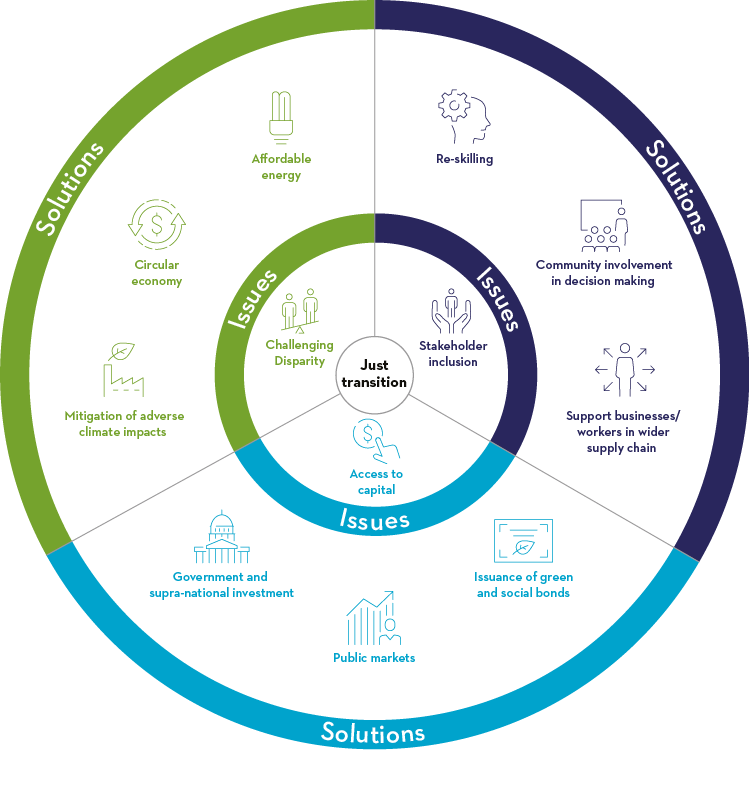
It is important for us not to leave anyone behind and to harness the opportunities for people, communities and enterprises that transition presents. We believe three of the biggest challenges facing a just transition are:
- Challenging disparity. Ensuring that the benefits and burdens of the transition are distributed fairly across different regions and communities is complex. We need to consider the impact on regions and communities that are more dependent on employment from fossil fuels. Substantial investment is needed to fund re-training and education for workers changing to new industries. Affordable energy needs to be available to all, ending- not worsening- fuel poverty. The Global South (that broadly comprises Africa, Latin America and the Caribbean, Asia, and Oceania) needs a stronger focus, as countries with fewer economic resources and limited social safety nets may struggle to meet the pressures on livelihoods. The circular economy has a role to play here in making better use of existing resources and products while reducing waste and pollution. This can also aid the mitigation of climate related socio-economic impacts through food/resource scarcity and adverse weather.
- Stakeholder inclusion. It should almost go without saying that to make the transition ‘just’, engaging with workers, communities and businesses is crucial. Otherwise, the needs of those most affected may not be addressed. This includes how companies adopt fair labour practices and involve local communities in decision-making processes. Re-skilling is key to this, but it must provide workers with the education relevant to changing workplaces, for example digital skills. There is also the ‘informal sector’ to consider, how are businesses and the workers in the wider supply chain impacted? What impact does this have on the safety and resilience of a community?
- Access to capital. New financing instruments are needed to help achieve the transition. The European Commission has launched the Just Transition Mechanism, based on three pillars: a Just Transition Fund, a just transition scheme under InvestEU, and a public sector loan facility. This initiative has not been without contention regarding distribution of funds between different countries. Issuance of green, social and sustainability (GSS) bonds have grown in the last 10 years, after a peak of almost a USD 1 trillion in 2021, c.USD 850 billion were issued in 2023. The vast majority are however green bonds, with social bonds accounting for just over US$150 billion of the 2023 issuance2. Further issuance of social or wider sustainability bonds could appeal to many socially responsible investors to raise capital for transition projects. But in providing funding, we strongly believe in the role of public markets to accelerate investment and aid scalable solutions. We discuss this further below.
What role can asset managers play?
The private sector can support the process through company-level practices and by facilitating corporate investments in a just transition.
A holistic approach needs to be considered. Through public markets we can invest in companies that help society adapt and become more resilient – physically and economically speaking – to the uncertainty that lies ahead. They do this by re-skilling workers, increasing their efficiency or resource usage, and improving the safety and resiliency of communities. The provision of financial services to underserved communities through microloans and savings accounts can improve financial inclusion and increase financial resilience.
How can we help stakeholders and provide communities with voices? Asset managers, through proper due diligence, can seek to identify those companies who are materially helping the transition and supporting stakeholders. This can be through innovative products and services from well governed companies, they have economic incentive to aid the transition as it helps the firm’s bottom line.
As asset managers we can also consider what the material impacts are both up and downstream on suppliers and consumers. A firm might consider its environmental offsets, but what is its impact on actual people, especially in more disadvantaged regions?
Targeted engagement by asset managers focusing on these material issues can improve corporate behaviour, and accelerate the positive change created by the firm’s products and services.
The financial sector can also advocate at an industry and government level for policies that support a just transition, such as subsidies for green technologies, social safety nets for displaced workers, and regulations that promote fair labour practices. Collaboration with other investment firms and investor-led initiatives can amplify these efforts.
Reasons to be optimistic
There is real momentum behind a just transition; we are seeing more carbon reduction and low emission policies now including explicit references to economic diversification, job creation, skills training, and social protection. The International Energy Agency has established a Global Commission on People-Centred Clean Energy Transitions, with its principles based on energy affordability and socio-economic developments. Several countries have implemented coal transition plans including Canada, Germany, Czechia, Spain and South Africa. They have varying approaches, and are at different stages of implementation, but all acknowledge the need for reskilling and community impact.
We are seeing innovation at companies offering technological solutions to mitigate the impact of climate change for communities. In the just transition space this includes companies that are focused on reskilling people from overlooked cohorts for high demand areas. Supporting the circular economy are companies helping improve the efficiency and resiliency of industrial processes, especially in the food and health sectors, or recycling wastewater. Others are providing solutions to support communities through resilience to natural disasters or improving the safety of more sustainable forms of transport.
As asset managers we are optimistic. We see improvements in disclosure around sustainability topics by companies, but we note that this is still developing. At Martin Currie, our own impact strategy’s company engagement has primarily been around this issue. Specific engagement with companies can also help accessibility of impact, for example encouraging expansion of products or revenue generation in regions such as emerging markets. By setting clear metrics and targets for products and services that deliver positive social outcomes, asset managers can track progress and ensure accountability to underlying investors. That way we can use public market investment to help accelerate a just transition.
This guest article was written by Lauran Halpin, Head of Impact Equities, and was published in Martin Currie’s 13th edition of Stewardship Matters that focusses on social impact and the potential of public markets to address societal challenges while assessing the risks these issues present to achieving financial returns for investors.