


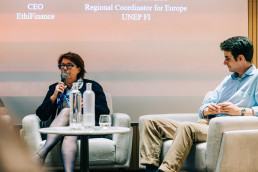

The second panel of the summit explored the complexities, challenges, and opportunities in ESG integration, diving into how businesses can move beyond viewing ESG as a compliance burden. Panelists Sébastien Thevoux Chabuel, Carol Sirou, and Daniel Bouzas shared their views on how regulatory landscapes, data utility, and sector-specific standards are shaping the ESG journey, comparing European and US approaches, and reflecting on the potential for meaningful ESG action over the next few years.
Comparing Regulatory Landscapes
Sébastien set the stage by reflecting on the enthusiastic momentum around ESG before COP26, when regulation wasn’t as prominent a focus. Today, however, with regulations expanding, investors are faced with increasingly complex regulatory landscapes. Sébastien highlighted the differences between Europe and the US, noting that Europe is often criticised for over-regulation, yet paradoxically lags behind the US in enforcement. This disparity, he suggested, creates a challenge for investors, who may struggle with confidence in ESG standards’ efficacy. The need for balanced, enforceable standards that go beyond compliance to drive measurable impact was a recurring theme throughout the discussion.
Navigating the ESG “Teenage Crisis”
Carol offered a compelling analogy, describing the current state of ESG as a “teenage crisis.” She noted that as ESG evolves, businesses need to shift their mindset from viewing compliance as a burden to leveraging ESG metrics to improve overall performance. Carol focused on the complexities of ESG data, where existing quantitative scores often fail to provide actionable insights. This is where the upcoming EU ESG rating system could play a role, enabling more meaningful, comparable assessments of corporate sustainability. Carol also discussed companies’ reluctance to establish ESG benchmarks, noting that fear of scrutiny often holds them back. However, she predicted that with targeted education and a focus on relevant key performance indicators (KPIs), the next 3-5 years would bring real progress in integrating ESG standards that drive results.
Challenges in Implementing ESG Standards
Daniel addressed the varied approaches to ESG within sectors, contrasting the paths taken by companies like Schneider Electric and APB. He explained that while progress on ESG implementation is still emerging, frameworks like the Corporate Finance Disclosure Regulation (CFDR) are instrumental in raising awareness of greenwashing risks. Daniel highlighted Europe’s unique reliance on banks for corporate finance, with 60-70% of companies’ external funding coming from them. This reliance makes sector-specific standards essential, he argued, as they guide both banks and corporations in aligning with ESG goals and fostering comparability. Such standards, Daniel suggested, will play a critical role in ensuring that ESG integration is not just a compliance checkbox but a genuine driver of change across industries.
The Path Forward: Embracing ESG as an Integrated Business Strategy
The panel concluded with a shared outlook on the “teenage crisis” that ESG finds itself in: a phase where rapid growth and complexity require companies to move beyond simple compliance. While regulations will continue to expand, the real task lies in ensuring these frameworks promote proactive, impactful ESG actions.
As Carol, Sébastien, and Daniel all emphasised, the coming years will be critical. Companies must engage with ESG not merely to meet standards but to transform their approach to sustainable performance. For leaders, this means focusing on transparency, harnessing quality data, and establishing relevant, comparable benchmarks to bridge the gap between compliance and performance.
Key Takeaways
- Enforcement vs. Over-Regulation: Europe faces criticism for heavy regulation yet lags behind the US in enforcement, creating challenges for investors seeking efficacy.
- Moving Beyond Compliance: Viewing ESG as a tool for performance improvement rather than a burden will be crucial as regulations increase.
- Sector-Specific Standards: With banking as a major source of external funding in Europe, sector standards are essential for guiding and enabling effective ESG action.
As ESG matures, businesses will need to embrace this “teenage crisis” phase, evolving towards a future where sustainable practices are fully embedded in business strategy, driving long-term value for stakeholders and communities alike.